

Improved earnings but uncertainty prevails
Before the election, the Australian Bureau of Statistics (ABS) released two critical figures of economic data to universities. The first release pertains to the Commonwealth expenditure on tertiary education and the second pertains to Australia’s earnings in educational services exports.
The aim of this commentary is to unpack these economic findings and highlight key opportunities and challenges for the sector following the re-election of the Albanese government.
Commonwealth expenditure on tertiary education
The Commonwealth expenditure on tertiary education increased by 9.0% or $1.3 billion from $14.7 billion in 2022-23 to $16.1 billion in 2023-24, accounting for 2.3% of total expenditure.
However, the Commonwealth did not increase funding to universities. Rather, the increase is based on the Consumer Price Index (CPI) component and growth population factors. Universities’ Commonwealth base agreement grants increased in 2024 at a higher rate (about 7.8%) compared to previous years because of higher inflation.
After two consecutive years of decline in expenditure, Commonwealth expenditure on tertiary education went up by 9.0% in 2023-24. However, over the past decade the Commonwealth expenditure on tertiary education as a proportion of all expenditure is down.
Since 2016-17, expenditure on tertiary education has been below 3%. During the period between 2009-10 and 2015-16, Commonwealth expenditure on tertiary education exceeded 3%, with the highest proportion in 2009-10 at 3.4%.
In contrast, Figure 1 shows the Commonwealth expenditure on defence has increased from 5.9% in 2009-10 to 7.1% in 2023-24.
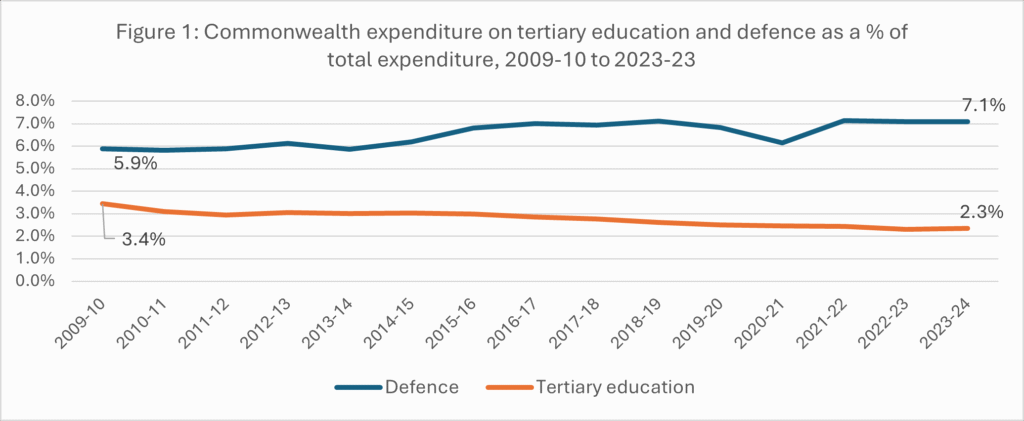
In 2023-24, the Commonwealth spent 203% more in defence than in tertiary education compared to 71% in 2009-10. Given the seismic geostrategic changes we are witnessing, it is likely that governments in Australia and liberal economies will further prioritize defense spending or begin to combine civilian focus with defence-related objectives. These governments are also now prioritizing funding in-line with national security priorities or areas that enhance national sovereignty.
Educational services exports
In 2024, Australia earned $51.5 billion for the export of educational services, up by $4.6 billion or 9.8% from 2023. China and India continue to be the two main source countries for international students and made up $42.2% of earnings in 2024, down from 47.2% in 2019
Students paid $16.8 billion in fees to higher education institutions in 2024, up by $3.2 billion or 23.6% from 2023. In fact, higher education institutions earned in 2024 more than doubled what they earned in 2022, when Australia fully reopened its international boarders to travellers vaccinated against the coronavirus.
In the coming days, annual reports from universities in New South Wales and Victoria will be released and these will provide details on universities’ earnings from international students. Annual reports from universities in Queensland and Western Australia were released a few weeks ago and show year-on-year increases in revenue from international students.
Staff numbers are also up
Although universities’ earnings appear to be up, expenses continue to rise, with the CPI rising 2.4% over the 12 months to the March 2025 quarter.
The largest amount of universities expenditure is on paying employee benefits and on-costs, which accounted for 55.4% of universities expenses in 2023. The latest staff figures published by the Australian Department of Education indicate there were 122,589 full-time equivalent staff in Australian universities, up by 5,730 or 5.1% from 2023.
This figure also surpasses the previous highest number recorded during the pandemic year of 2020 (116,859).
Over the period between 2018 and 2024, the number of staff in universities increased by 8.8%, and the growth in academic and professional staff was almost the same. In 2024, the proportion of professional staff was the same as in 2019 at 57.1%. Despite the financial difficulties experienced by universities, the number of staff has continued to climb.
Labor government roadmap
The re-election of the Albanese government means that the Government is committed to Managed Growth Funding, the Australian Tertiary Education Commission and Needs-Based Funding. The government is also committed to making Free TAFE permanent, raising the repayment threshold, and lowering the payment rate for student debts.
In practice, it means that universities need to have a student-centric vision if they are to strive financially and be regarded in good esteem. Equipping learners to succeed means increasing the levels of support along all stages of the academic journey and beyond.
On the international front, there is also the opportunity to regain the momentum lost due to the politicisation and dehumanisation of international students.
Additionally, the Albanese government will need to provide clarity on the international onshore student caps and decide if it wishes to retain educational services exports as a pivotal sector to Australia’s economy.
The number of international students in the United States is declining, and so far, there have been 100,000 fewer students from Asian countries between March 2024 and March 2025. In 2023, the United States earned more than US$50.1 billion (A$77.6 billion) from international students, and this year is likely to experience a decline in revenue of at least US$4.4 billion (A$6.8 billion). Here lies a prime opportunity for Australia to bolster its credentials as a host country for international students.
Opportunities and challenges
The underlying financial position for Australian universities will continue to be challenged due to increasing costs, weak domestic demand for study, uncertainty on the number of international students allowed to enter Australia, and geostrategic shifts that are under way.
It is unlikely that the federal government will increase its expenditure on tertiary education at the level of the 1990s or mid-2010s. Universities will need to focus on strengthening the quality of educational delivery instead of building mass.
Collaboration is fundamental to universities as it can bolster the ability to innovate. Over the years, universities have worked together to find solutions to common issues. Unsurprisingly, this is why in Australia there are four university alliances in addition to the national umbrella of universities.
Through sharing resources, universities can fulfill their vision, long-term financial sustainability, and progress the spirit of the government’s Universities Accord. Instead of having 43 separate student systems, there is scope for a single unified national system. At the same time, universities could build a unified human resource system. These two bold ambitions could deliver significant gains to universities, including reducing operational inefficiencies.
Improved university processes can also deliver significant productivity gains to universities.
It is likely that the re-elected Labor government will focus on improving productivity across Australia’s service economy. The pandemic delayed the continued third wave of economic reform which the federal government has embarked on to increase productivity. Through the Acord, the government seeks to achieve higher levels of educational attainment.
It is inevitable that universities will need to focus on improving student engagement and quality of teaching. To achieve these two objectives, universities’ most important assets are their people who can make it possible.
Angel Calderon is a higher education global expert.