
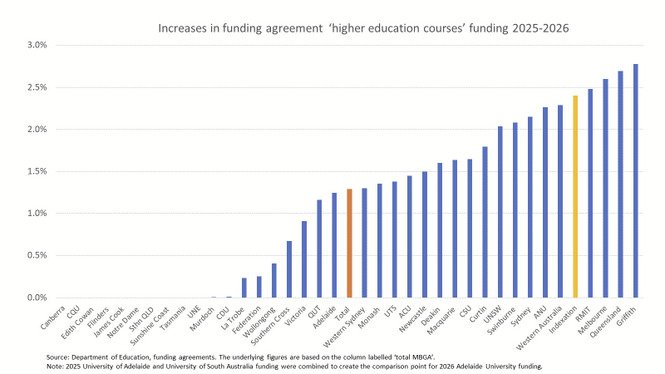
Griffith University received the largest increase in Federal Government funding for higher education courses in 2025-26, followed by the University of Queensland and the University of Melbourne – while 10 universities received no increase at all.
Analysis by Australia’s leading Higher Education policy expert, Monash University’s Professor Andrew Norton, examined the Government’s changes to higher education funding agreements, which have been revised to remove growth funding for universities that undershoot their enrolment.
The 10 universities with zero growth in higher education courses funding – Canberra, Central Queensland, Edith Cowan, Flinders, James Cook, Notre Dame, Southern Queensland, Tasmania and New England – were presumably under-enrolled in 2024. In contrast, universities that achieved enrolments in line with their quote will receive funding growth supposedly with inflation (2.4%) while universities that over enrol may be eligible for additional funds.
“Given the large amounts of money paid in recent years to universities for not delivering student places it is hard to oppose less generous funding guarantees,” Professor Norton writes
“Despite government claims last year about additional student places for 2026, if this happens it won’t be due to increases in Commonwealth Grant Scheme higher education courses funding for public universities. This will fall slightly in real terms.
“Instead, the government is trying to use the CGS resources it already provides more effectively. It is steering funding away from universities that have not fully used their MBGAs and directing less funding through ad hoc allocations of student places.”
From a marketing perspective, the policy helps to reinforce the existing pecking order among universities, when impact of over or underenrolment is viewed in isolation. Institutions with smaller marketing budgets, lower rankings and fewer competitive attributes in attracting students (because of regionality, low status, low profile etc) tend to be over-represented in the lower half of the funding growth.
In looking at other factors beyond just growth affecting government funding, Professor Norton found that most universities received some level of funding growth.
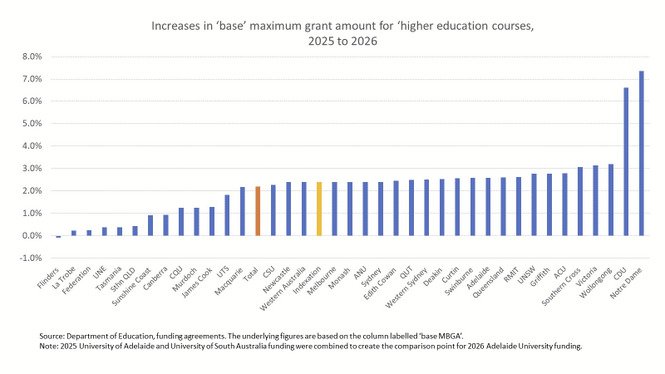
“CDU is one of only four universities never to receive an under-enrolment handout, so a likely history of over-enrolment. Notre Dame was under-enrolled in 2023 but since then has experienced major increases in student contribution revenue, suggesting strong enrolment growth.”
Whichever way you cut the data, the performance and focus of marketing and recruitment teams will surely be recalibrated to improve funding outcomes if this formula remains in place when ATEC seize the wheel, determining funding handouts from next year. As avenues for growth are squeezed, ability to meet government performance metrics is going to be increasingly important to the bottom line in coming years.