

Opinion
To The Australian Senate:
I express a belated ‘no’ to refer to the Education and Employment References Committee the inquiry regarding Australian university graduates and their employment post-graduation. It may be well-intentioned, but its terms are imprecise, it covers overly trodden ground, it is poorly timed and is unlikely to have any substantive impact. Here are the reasons.
Procedure and Referral Speech
Whilst respecting Senate procedures, email advice from Senate officials note the vote was determined ‘on the voices’ with relevant video suggesting there were six Senators present in the chamber around the time of the vote; ~ 8% of all 76 Senators. Perhaps the referral was arranged outside the chamber; if so, it illuminates Senate process. Any University Council making like significant decisions with an inquorate 8% would have their governance practices condemned.
Strong graduate employment is a legitimate policy issue. However, the referral arguments need to be sound. Speeches may be brief, but context matters. The Hansard record 12 March 2026 (pp95-96) notes that 26% of 2024 graduates had failed to obtain full-time work within six months. Second, that graduate job postings declined by 24% in 2024 and 16% more in 2025.
The 26% figure refers to graduates without full-time employment at the four-to-six-month Graduate Outcome Survey (GOS) point – not to graduates who have permanently failed to find work. The longitudinal GOS data makes this clear: graduates who were at 71% full-time employment immediately after graduation in 2021 were at 91% full-time employment three years later. The short-term stress is real, but it is not the permanent failure implied.
The 24% decline in graduate job postings in 2024 is a year-to-year drop, with 2023 a post-pandemic peak. Graduate postings in 2024 were still 1.7 times higher than in 2019. The decline is a concern but more of a cyclical trend and a return from an unusual high. Multiple factors explain it (below).
Any self-harm is tragic. The referral speech 23 March (pp 91-92) stated "In 2024, suicide was the leading cause of death for Australians aged between 15 and 44". This appears sourced from the ABS Intentional Self Harm Deaths 2024. Direct juxtaposition of graduate unemployment with suicide rates implies a causal connection, an inferential leap the research does not directly support.
Evidence on education, unemployment and suicide is multifaceted. The Australian Institute of Health and Welfare reports broadly an inverse relationship where the estimated suicide risk is higher among those with fewer years of education. For males aged 25–54, the cumulative suicide risk for those with only secondary school or lower education is 2.6 to 3.5 times higher than for those with a university degree; with lower risk among males having a bachelor's degree or higher. The gap in risk between education levels also exists for females, though it is less pronounced (1.6 times higher for those with less education compared to those with a degree).
While unemployment increases risk, having a bachelor's degree or higher provides a supportive protective factor. The far higher risk is not graduates struggling to find full-time work four months after graduation; it is people who have not accessed higher education at all.
Prolonged graduate unemployment is known to have psychological impact. Research shows risk to mental health for graduates who cannot find jobs aligned with their studies, of ‘scarring’ when graduating during economic downturns, of loss of identity, financial debt, and frustration at unmet wage and career expectations and stress of under or unemployment. Universities are all acutely aware of this. But to what extent can universities be accountable for graduate job openings?
The Six Terms of Reference are:
- the state of the entry-level job market for graduates;
- the quality of university education in Australia;
- whether graduates of Australian universities are being taught the skills that employers are looking for;
- the state of affairs in comparable jurisdictions;
- the economic, social and psychological effect that this experience has on graduates; and
- any other related matters.
Don’t ask for submissions – absorb what exists
The Senate has available existing contemporary detail of the Australian labour market including that of entry level job market for graduates via bodies like Jobs and Skills Australia (JSA), e.g. JSA’s Vacancy Report, the ABS, relevant Government departments, Indeed Hiring Lab plus ten Jobs and Skills Councils each contracted to provide an annual workforce plans for their designated industry sectors, all of which is further supported at regional level by state bureaucracies. Governments support hundreds of staff and spends many tens $m per annum on such matters e.g. Jobs and Skills Report 2025 etc. Ask JSA for a succinct summary to cover the first Reference term. It will well do.
Is it weak productivity and lack of jobs rather than ill-equipped students?
The Referral too simplistically under emphasises the labour market ‘demand side’ drivers; like macroeconomic conditions, private sector hiring cycles, the normalisation of post-COVID hiring peaks, and the growing emergence of AI as a disruptor of entry-level roles. This is not the time to rake over, yet again, well-trodden and over emphasised ‘supply side’ questions of "the quality of university education in Australia," and “graduates… taught skills that employers are looking for”.
Answers lie more in the Senate Select Committee on Productivity in interrogating Term 1. Here is a kick start. Perhaps private business hiring confidence for graduates was slugged by thirteen interest rates rises over 2022-24. Examine the impacts on both non-market and market sectors (Fig.1).
Fig 1: ABS Quarterly Job Vacancies by Non-Market and Market Sectors (LHS) vs Cash Rate (RHS)
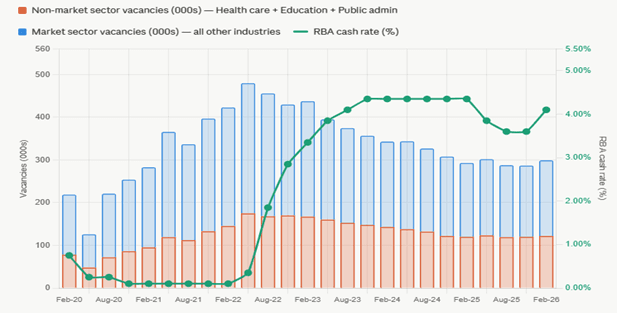
Note: Non-market sector is defined here as the ABS (Labour Account / National Accounts) groups Health care & social assistance, Education & training, and Public administration & safety as a proxy for the non-market sector — organisations whose output is not primarily sold at market prices, and which operate largely on government funding. Crucially, ~55% of non-market sector jobs are private sector employees (e.g. private hospitals, non-profit aged care, Catholic schools)
A longer-term view of graduate employment
Figure 1 shows data for all job vacancies, not just ‘graduate’ vacancies. A proxy for graduate-specific vacancies is the Indeed Hiring Lab's tracking of job postings with "graduate" in the title, and the government's Graduate Outcomes Survey (GOS / QILT), which surveys graduates 4–6 months after completion and again at 3 years. JSA’s routine Vacancy Report (on-line jobs) also commendably tracks advertisements at Skill-Levels (e.g. Skill Level 1 Bachelor degrees or higher). Its latest report notes over the year to March 26 all online job advertisements increased by 4.7% (or 9,700 job ads).
Nine years of authoritative QILT Graduate Outcomes Survey (GOS) data shows undergraduate full-time employment rates have followed a broadly cyclical pattern (Figure 3 2024 GOS ) : stable in the high 70s % levels pre-pandemic (2016–2019), declining to the high 60s during COVID (2020–2021), recovering strongly to 78–79 per cent (2022–2023), and then falling back to 74 per cent in 2024, higher than pre-COVID. Postgraduates’ employment exhibits the same general trend but noticeably with higher full time employment rates. Not a crisis, though with future uncertainty in impact of AI.
These data broadly track the overall vacancy cycle (Fig. 1): the rate hike period squeezed employer confidence and so market sector ‘graduate demand’ fell first and fastest. Graduate job postings fell 24% in 2024 compared with 2023, tracking 16% lower in early 2025, with hints they are now lifting.
Norton's analysis, frustrated by inexplicable lags in publication of the GOS, also draws on ABS labour force data and job advertisement indices. It confirmed the decline in graduate outcomes between 2023 and 2024, with more recent ABS data suggesting that 2025 GOS results might be slightly better than those in 2024. He notes ~19% (2023 GOS) of undergraduates said they had secured a job via a work-integrated learning employer and ~10% through a network contact. This tends to suppress visible posting share, an observation that opens important structural insights.
Structural divergence in the jobs advertised/available to graduates
Health, education, public administration is the more reliable graduate employer across the cycle, 2020-24 but it recruits graduates differently. Healthcare (nursing, allied health, medicine, social work) absorbs graduates through clinical placements and direct institutional hiring so are prone to being systematically undercounted in online job posting data. Over the past five years, healthcare & social assistance has added around 670,000 jobs at an annualised rate of 6.3% a year, accounting for ~a quarter of all job gains. Growth has more recently slowed, but non-market sector graduate demand (health, education, disability services) is inherently more structurally sustained by demographics, legislated spending, and workforce pipeline needs, that don't respond to cash rates.
By contrast, the market sector for graduate demand (e.g. finance, consulting, tech, engineering, construction) is more cyclical and moves in closer step with RBA rate changes climbing through 2021–2023 when money was cheaper, falling when borrowing costs dampened firms forward hiring. Compared with the non-market sector, it is better represented in online postings, which rise and fall, for graduate roles on market conditions.
This means employment %s cited in the Referral may have near nix to do with "quality of university education” and “being taught the skills that employers are looking for”. Referral 2 and 3 may not be the explanatory variable. It’s parliaments, policy and productivity that spark new jobs for graduates.
What employer satisfaction surveys show
The QILT Employer Satisfaction Survey (ESS) provides the only systematic national measure of how direct line supervisors rate the graduates they manage. Running since 2016, it uses a rigorous methodology connecting GOS graduates to their supervisors and covers ~3,000–4,000 employers annually across all broad fields of education.
The ESS findings (noting limitations of survey size and any bias) are consistent, year on year, and striking in their positive direction. In 2025, overall employer satisfaction with graduates was above 84%. Supervisors rated graduates as well prepared for their jobs at 95%, substantially higher than how graduates rated themselves at 86%.
The consistent finding is that people with direct supervisory experience of recent graduates are overwhelmingly saying they are satisfied; and it’s more rising than falling, across a nine-year series.
What comparable international evidence shows
QS Global Employer Survey data drawing on responses from more than 85,000 employers across 80 countries consistently identifies problem-solving, communication, teamwork, and adaptability as the most important graduate attributes. It’s not fundamentally or only about acquired knowledge.
A QS 2026 analysis notes "employers are not saying graduates lack theoretical understanding”…and that “skills employers describe as missing are rarely technical or sector-specific. They’re the transferrable capabilities that determine whether graduates can use what they’ve learned in real workplaces – especially when problems are ambiguous, time-pressured, and increasingly shaped by AI”. Graduates need exposure and experience to learn to apply theoretical knowledge to workplace reality. The GOS and ESS data says Australian universities are not oblivious to these imperatives.
Graduate ‘attribute’ frameworks from all Australian government-funded universities have also been systematically analysed. These collectively cluster consistently around eight themes that align with the same attributes the QS Global Employer Survey identifies as important to employers globally.
The Cengage Group's 2025 Graduate Employability Report which covers the US found that personal referrals, internships, and prior work experience were more decisive in securing employment than the degree itself, yet one in five graduates reported their education program did not help them foster professional connections. This highlights an employer engagement issue not a curriculum problem.
So, Australian universities are not way off beam with the rest of the world, nor uniquely deficient.
Flawed terms, ill-timed and a submissions treadmill
The Referral terms are both too broad (covering everything from entry-level job markets to the psychological effects on graduates) and too narrow (implying that university education quality is the primary driver of outcomes that are manifestly shaped by macroeconomic conditions). Having done with the HE Accord and SERD reviews and needing to engage with new processes led by ATEC, universities should have greater priorities elsewhere, as would other stakeholder submitters.
Whether stakeholders agree and approve or not, the outcomes are that the Government is steadily implementing multiple funding, legislative, policy and quality reforms, with ATEC legislation the most recent. Far better to pursue inquiry of Terms 2 and 3 in ~2-3 years, after ATEC and university compacts have been up and running. Rummaging in this space again risks much futile repetition.
A more productive framing
The transition from education to employment is a system-level relationship challenge. It requires active employer participation, joint investment in work-integrated learning, and labour market flexibility as the levers for change. The Senate would also better spend its time assessing national workforce AI proficiency levels, compared with other nations, as a future looking insight. It is these issues that should be focus of Senate inquiry. None sit solely as university accountability. And ask why the unnecessary delays in the GOS publication, such that by the time the committee reports, it risks working from data about graduates who finished their degrees in 2023/24.
Maintain perspective, not prejudice
Universities as institutions are under scrutiny, navigating a major funding and structural change. Their collective allegation ‘rap sheet’ is extensive: ‘VC’s pay, business vs public education purpose; industrial disputes; staff under payment; student safety, mental health and harassment; delivery quality post COVID; international student imbalance; AI and assessment integrity; social (in)cohesion; research sovereign risk; council governance etc’. It’s all fodder for media ‘crisis’. The risk is like that of the VET FEE HELP saga, the ‘dodgy provider’ tag stuck in many cases unfairly.
It’s also much under recognised that universities as people, academics, teachers, researchers and administrators – the overwhelming many – turn up every day for students and do such a great job in sustaining national performance and our international reputation. Cheers to them and keep going.
Dr Craig Fowler runs JCSF Consulting and has held a wide range of roles across the Tertiary Sector, including former Managing Director of NCVER.