

Opinion
This article is the second prompted by content in the AHEIA conference speech made by UA’s CEO Luke Sheehy. The first examined regulatory burden impacting universities. This article explores his statements on the erosion of institutional autonomy: “universities are not departments of state…”.
The purpose here is to evaluate public evidence as to whether, or not, UA has a justified gripe, and to assess to what extent. It’s an international perspective trying to position Australia relative to peer nations. It is not claimed that which follows is correct in all regards; it depends on implementation.
ATEC’s stewardship role – national interest and collaborative transformation
The Australian Tertiary Education Commission (ATEC) is a landmark commitment by the Australian Government to independent, system-wide stewardship of tertiary education. Its core mission is to drive equitable opportunity, allowing all Australians to access transformative higher education and vocational training, primarily via university-specific mission-based compacts.
Government/ATEC Domains of potential influence/control
ATEC’s remit is expansive. To illustrate this, a framework of eight Domains was designed (Table 1). This sets out policy areas by which ATEC and the Government would have the means, if desired, to exercise direct or indirect influence/direction over Australian universities.
Within this organising framework, each Domain D1-D8 was then ‘best fit’ populated with items of contemporary, highest profile ‘public policy or policy intent’ pertinent to each Domain, i.e. key existing and emerging policy items that are public, with potential for state ‘influence/control.
Illustrative examples include: the ATEC interim Statement of Strategic Priorities (May 2026), existing 2025–26 mission-based compacts, the SERD Final Report (May 2026), the Opening the Doors of Opportunity Bill (May 2026), the ATEC Discussion Paper "A More Joined-Up Tertiary System" (26 May 2026), ministerial announcements, plus multiple other contemporary public sources/content.
Table 1: Eight Domains of potential influence/change/control
| D1. | Indirect / signalled | Mission and institutional identity Who defines what a university is for [‘unis have plans, that fits in the grand plan’] |
|---|---|---|
| D2 | Active / direct | Domestic enrolment volume and discipline mix (a) CSP volume (b) Over/under enrolment with CSP redistribution (c) Equity/low-SES composition minimums, and (d) Discipline/program-level CSP allocation Who controls domestic student numbers, student profile and course profile |
| D3 | Active / direct (already exercised – deepening 2027) | International student volume, mix, origin & grad/ p-graduate balance Who controls overseas student numbers, source country, level of study and the revenue model underpinning universities |
| D4 | Indirect / signalled | Research direction and specialisation Who decides what universities research and at what scale |
| D5 | Indirect / signalled | Staffing and workforce composition Who shapes academic employment models |
| D6 | Active / direct | Governance and institutional leadership Who controls how universities are run and led and their regulation |
| D7 | Latent / reserved → Active / direct from Jan 2027 | VET–HE tertiary harmonisation and credit recognition Whether credit and curriculum decisions are institutionally or centrally determined |
| D8 | Indirect / signalled → Latent / reserved | Institutional structure, research obligation and the constellation model Who determines what type of institution a university must be – including how much and whether it must do research at all |
NB: All D1-D8 content was compared against international university systems using AI tools.
World view of universities
University governance systems worldwide sit on a spectrum between two poles. At one end: state-directed systems where governments operate universities as instruments of economic and social planning and direction. At the other: market-liberal systems where institutions compete for students, resources and prestige with minimal government interference beyond quality assurance.
The details by country are way more complex as university systems cluster across this range. Each is a unique and long run fashioning of their nations’ political and governance structures, their history and tradition, their wealth and economy, society and demographics, cultures and values.
The European University Association’s (EUA) University Autonomy Scorecard is a rigorous comparative measurement of university institutional autonomy in Europe. It benchmarks the regulatory frameworks governing public universities across 35 national systems, using more than 30 indicators grouped into four autonomy dimensions: organisational, financial, staffing, and academic autonomy. It provides a structured, weighted benchmarking of national restrictions and enablers.
Conceptual depictions of university systems autonomy vs central control
Figure 1: International Distribution of University System Autonomy vs Central Control
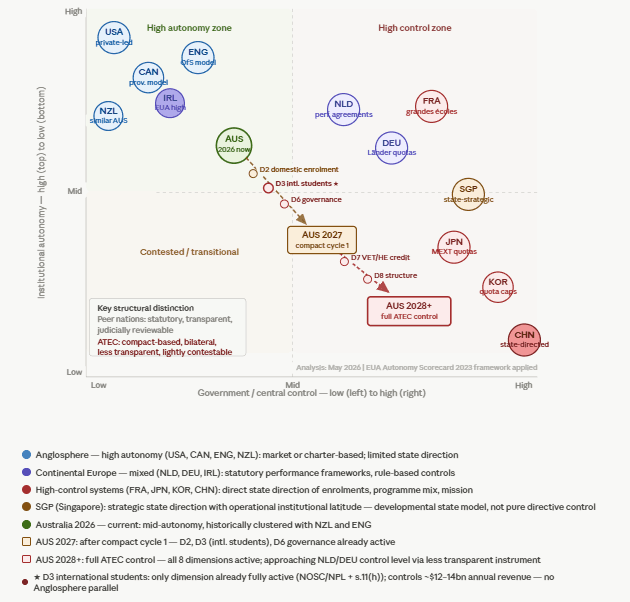
Figure 1 is quadrant plot of institutional autonomy vs government control for the nations shown.
Positioning was based explicitly on multi-country evaluation of all 8 Domains (Table 1). It places Australia ‘as now’ and shows a trajectory of ‘possible future’ assuming sequential changes (e.g. via compacts) implementing the elements of reform and influence/control identified in the 8 Domains.
Be clear, Australia’s trajectory as seen in Figure 1 is a hypothetical shift of position, much dependent on ATEC’s/Government’s actions, both current and future. It illustrates the magnitude of potential direction change. Positioning of other nations may also not be static over this period.
Figure 2: International Distribution of University Systems per EUA Scorecard
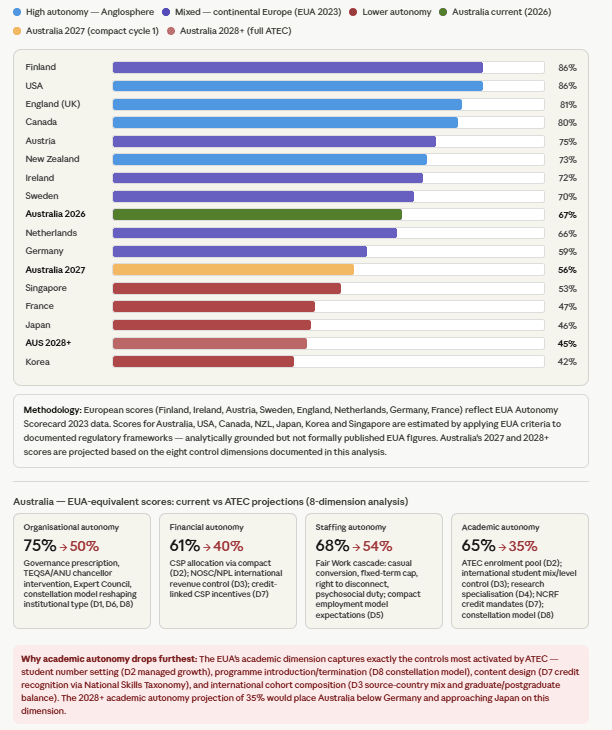
Figure 2 is a bar graph of multiple EU nations, plus others, as a composite based on the EUA Scorecard that assesses across the four dimensions of university autonomy: organisational, financial, staffing, and academic, taking account of the ‘8 Domain public policy or policy intent’. It also illustrates the potential of incremental strengthening in the control role of ATEC over time.
The lower table in Figure 2 shows a projected scorecard change, a direct significant regression in autonomy in all four measures including academic autonomy (by restricting student numbers and degree profiles) and financial autonomy (by tying resources to government-designated priorities).
Observations from international peer analysis
Australia has long occupied the top quartile of OECD nations for university autonomy -broadly comparable with England and the Netherlands, and well above the more directive systems of France, Germany, Japan, and Korea. While absolute funding caps fluctuated, universities historically retained the ultimate autonomy to manage internal student profiles, determine curriculum, allocate revenue, and select institutional research priorities. Commonwealth influence operated primarily through formulaic funding blocks and broad statutory quality obligations via independent regulators.
Under the potential weight of ATEC’s architecture, Australia would move toward the middle of the spectrum, closer to the state-directed frameworks of Germany and Japan than to traditional Anglophone or Scandinavian models. This shift toward a more directive stance is not a global anomaly; several major international systems have long been more state-guided than Australia's.
In this narrow sense, one view is that ATEC’s potential impact represents an adjustment of Australian exceptionalism rather than a radical departure from international norms.
Australia’s ATEC has no direct international precedent
However, deeper inquiry of the ATEC model indicate two features that make it genuinely unusual among advanced democracies. The first is the nature of the compact instrument. In Germany, directive state controls are embedded in transparent, rule-based legislation subject to rigorous parliamentary oversight. In Japan, MEXT’s multi-year operational plans achieved mission differentiation, but at the cost of widespread institutional distress, humanities closures, and persistent academic resistance.
Australia’s model risks combining the control levels of these directive states with accountability and transparency mechanisms that are far less robust, leaving institutional destiny to bilateral closed door administrative negotiations.
The second feature is the unprecedented concentration of power. Outside of perhaps NZ’s Tertiary Education Commission, no major Anglophone system has attempted to place this many structural levers – including domestic place allocations, equity composition, discipline mix, VET integration, advice on international student caps, advice on standards and institutional form – within a single body operating under direct and explicit ministerial direction.
In the US, these functions are deliberately distributed across federal agencies, state legislatures, and independent accreditors. In the UK, they are split across the Office for Students, Research England, Skills England, and UKRI. Australia has consolidated a single point of executive influence over almost all the tertiary landscape (not all of VET), benignly labelling it 'independent stewardship.'
In Summary – fewer degrees of freedom
ATEC’s framework shifts HE and the tertiary system towards "instrumentalism" where universities are structurally treated as tools to achieve broader government economic goals. This is akin to how States Ministers have long directed their TAFE systems via e.g. annual statements of expectations.
Strategically and sensitively pursued, in pursuit of collaborative national interest, multiple positive benefits are expected from ATEC’s system wide stewardship. But this change confirms Mr Sheehy’s opinion: it will come with examples of teeth grinding ‘grin and bear it’ loss of university autonomy.
The Government via ATEC now has the means to ignite major architectural repositioning of our post school tertiary system. National leaders and citizens outside of the academic claustrophobe likely do not know, or may not care, but should be made aware.
Australia will not become an outlier in the degree of state direction of universities, but as things stand it will be distinct in the relative opaqueness of its instruments and the sheer concentration of executive discretion.
This sits in deep tension with the very traditions of academic freedom and institutional autonomy that Australia has historically championed, creating so many world class institutions.
Dr Craig Fowler runs JCSF Consulting and has held a wide range of roles across the Tertiary Sector, including former Managing Director of NCVER.