
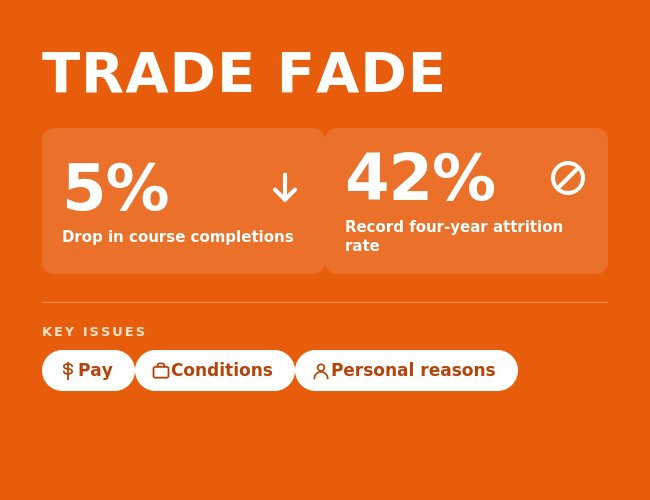
Apprenticeship completions have plummeted almost 5% according to data released yesterday, in a worrying sign for the Federal Government, as it braces for the release of the first tranche of Free TAFE completion data next year.
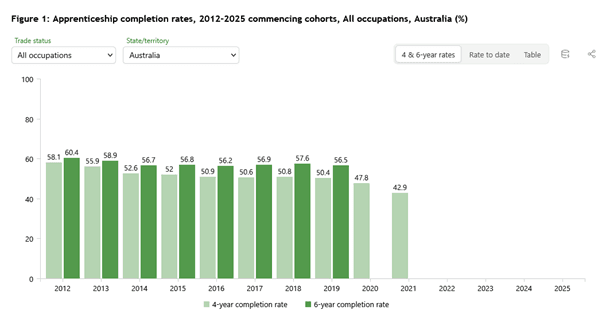
Four year completion rates (the proportion of students completing an apprenticeship four years after starting it) fell from 47.8% to 42.9% in the latest data from the National Centre for Vocational Education and Research (NCVER) , although politically all-important trades space, the fall was not so dramatic – down from 46.7 to 43.1% for four year completions and up by 0.4% from 58.3 to 58.7% on six year completions.
Source: NCVER
While a trend towards part-time apprenticeships and disruptions such as COVID have meant that experts now see six year completion as a more reliable indicator for trade apprenticeships than four year data, the report also indicates a jump in attrition.
The number of apprentices choosing to drop out of their chosen trade within four years now sits at 42%, the highest rate in more than a decade and around 4% higher than last year.
This means that of those who commenced apprenticeships in 2021, more than four in every 10 have chosen to drop out, and only 43% have completed their training within the standard four-year program time.
The tale is even worse in non-trade apprenticeships, with attrition at a record 56% and completions of 43% over four years.
Low pay, poor working conditions and personal reasons have been cited as key reasons for apprentices and trainees choosing not to complete their training.
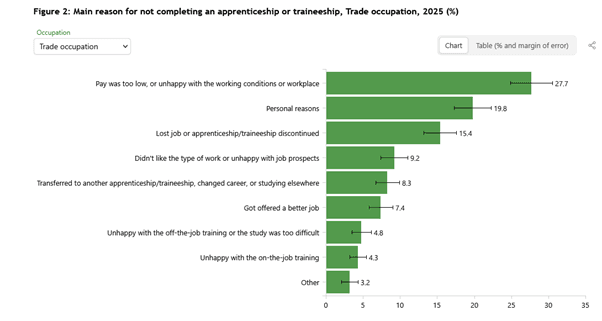
A separate 2025 survey of more than 24,000 apprentices and trainees conducted by NCVER looked at reasons for attrition, with 28% of trade non-completers saying that pay was too low, or they were unhappy with the working conditions or workplace and a further 20% quitting for personal reasons. 15% lost their job and a further 9% didn’t’ like the job and/or their work prospects.
In contrast, personal reasons (26%) and low pay or poor working conditions (25%) were the key drivers of dropping out for non-trade apprentices and trainees.
Source: NCVER
While 81% of trade non-completers were employed after training, just 40% still worked in the same occupation after dropping out of their apprenticeship, while far fewer (18%) of non-trade non-completers stayed in the same area.
Perceptions of the quality of training does not appear to be a key issue driving the downturn. 79% of non-completers were satisfied with their training and skills learned on the job in 2025.
NCVER Managing Director John King said that while trade apprenticeships were expected to complete within four years in the past, training times were lengthening.
“We do recommend looking at 6 years when looking at trade completions. It is reflective of the way people are changing how they work – there are a lot more part-timers doing trade apprenticeships,” he said.
Researchers had observed significant variability in attrition rates between occupations, but there wasn’t sufficient data to identify a consistent story across sectors, he said.
Yesterday’s report found that sparkies were the most tenacious groups, with 72% of electricians completing their apprenticeship within six years, whereas just 41% of cooks qualified during that time.