
Opinion
I have interviewed graduates with almost identical transcripts and very different capabilities.
A strong transcript might help someone get into a shortlist, but after interviewing graduates, often with almost identical transcripts, I found very different capabilities.
The transcript could not tell me whether they could explain an assumption, defend a judgement or reconsider their position when the evidence changed.
I have seen that limitation from several sides of the table. I began my career in the financial services sector, later hired and managed graduates across the public and private sectors, and now work inside a university.
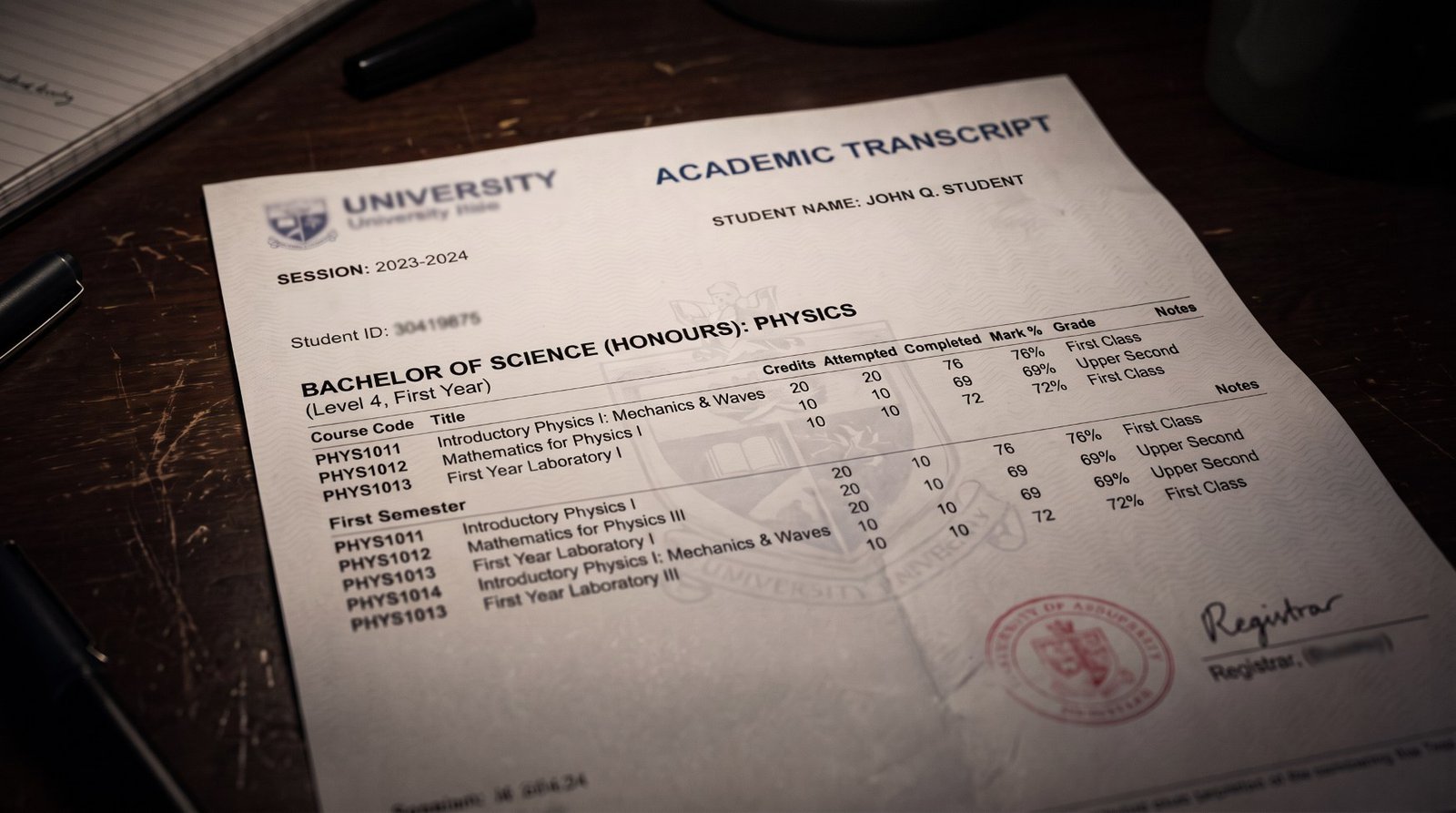
Generative AI has widened an old gap. A transcript has never captured everything an employer might want to know. A decade ago, it could not tell whether a student had contributed equally to a group assessment or relied too heavily on help from others. Today, the challenge is larger. The transcript still records subjects completed and grades awarded, but it cannot show what a student demonstrated independently, where AI was deliberately integrated into the task, or what evidence sits behind the university's claim about their capability.
Consider two students who both receive a distinction, assuming each has followed the assessment rules. One completes most of the intellectual work independently. The other uses generative AI to explore possible approaches, develop a draft and test their reasoning, while exercising judgement over the final result. Both may have learned and performed well. The conditions under which they demonstrated their capability were nevertheless different.
The transcript records subjects and results, not those conditions. That matters because Australian employers are asking for a richer signal.
Importantly, this is not an argument that AI-assisted work is inherently less valuable. In many professions, effective use of AI is becoming a capability in its own right. The challenge is that these are different claims about graduate capability, yet a traditional transcript makes little distinction between them.
Jobs and Skills Australia's June 2026 paper, Skills, Mobility and Productivity, argues that qualifications alone often provide an incomplete signal of an individual's skills and capabilities. It argues that people's skills need to be visible, portable and trusted.
The National AI Skills Forum report, published on 3 September 2026, adds urgency. It concludes that Australia's challenge has moved from AI adoption to AI capability, and that the difference between experimentation and impact lies in whether people can apply the technology effectively in real work. The report also calls for a human-centred skills passport that captures formal and informal learning.
Degrees still matter. However, both reports point toward a labour market that increasingly values visible, transferable and verifiable skills alongside qualifications. The question for universities is whether a traditional transcript remains sufficient as that signal.
Universities are already revising assessment. A TEQSA-commissioned expert resource, published in September 2025, notes that detecting unauthorised AI use with certainty is all but impossible and recommends authentic demonstrations of learning at appropriate points in a course.
The AI Assessment Scale gives educators a practical way to specify the role of AI in a task, ranging from no AI through planning and collaboration to full AI use and exploration. This is useful at the assessment level. In most cases, however, the condition disappears once the result reaches the transcript.
That is where assessment reform needs to connect with credential reform.
A July 2026 paper by University of Edinburgh researcher Kai Yao, calls this a problem of ‘credential validity’. If parts of the cognitive work can be delegated to AI, an institution needs to explain which human capabilities the credential establishes and what evidence supports that claim.
Universities have never captured every attribute an employer values, and transcripts have always been imperfect proxies for capability. AI makes the gap harder to ignore, because similar outputs can now reflect very different underlying capabilities. One student may have demonstrated independent reasoning, while another may have delegated much of the cognitive work to an AI system. The artefact alone no longer tells the full story..
In July, MortarCAPS launched the discovery phase of a proposed learner-owned Human Capability Record, with participants including Commonwealth Bank, KPMG, the Australian Computer Society, VTAC, the University of Sydney, UTS and Western Sydney University. The initiative is still at the design stage, but it is examining how experience, judgement, collaboration and leadership could become more visible and portable.
Overseas, Brandeis University is rolling out a supplementary Second Transcript for verified experiential activities and microcredentials. The technical foundations also exist. The 1EdTech Comprehensive Learner Record standard supports portable, learner-controlled records containing verified achievements, competencies and workplace evidence.
Technology can enable university records of achievement to be far richer. Universities first need to decide what they are prepared to certify.
A useful learner record should answer four questions. (1) What capability is being claimed, and at what level? (2) Under what assistance conditions was it demonstrated: independently, with limited tools or through deliberate AI integration? (3) In what context was it shown: a controlled assessment, project, simulation, placement or workplace? (4) What evidence supports the claim, who verified it and when?
These dimensions should remain separate. A workplace placement may involve extensive AI use. A supervised oral defence may test independent reasoning about an AI-assisted project. Describing the context does not tell an employer what assistance was allowed, and describing the assistance does not establish whether the task was authentic.
This need not replace the degree or the transcript. A degree is the university's formal certification. A transcript records the subjects completed and results awarded. An evidence-rich capability record would supplement both by making selected claims more precise.
The optimum form of student achievement record would be concise and selective. Recording every prompt or monitoring students continuously would turn it into surveillance; handing recruiters a sprawling portfolio would make it unusable. Evidence might include a verified capstone, a supervised demonstration, an oral defence or a placement supervisor's attestation. Students should control what they share, and employers should be able to interpret it quickly.
No single university office can own this work. Academic boards should define capability claims and acceptable evidence, while course teams verify them and registrars encode them consistently. Institutional accountability matters: universities should be able to explain who is responsible for each claim and the evidence behind it. Employers and students should also help test whether the resulting record is useful and intelligible. If universities cannot provide a credible signal of graduate capability, employers may place greater weight on work samples, assessment centres and other forms of direct capability assessment. Universities may choose not to respond, but doing so risks making their own credential less informative at a time when employers are increasingly seeking evidence of what graduates can actually do.
Universities should continue to provide transcripts and degrees, but they should also provide a complementary record that explains selected capability claims in greater detail. That record could indicate what was demonstrated, under what conditions, in what context and on the basis of what evidence. Together, these records would tell a much richer story than marks alone.
In an age of abundant machine-generated output, marks alone often provide an incomplete picture of graduate capability. An improved student record would strengthen graduate profiles, empower employers to find the graduates they need, and protect the reputation of universities.
Dr Alex Antic is Head of AI Strategy at UNSW Canberra, where he is also an Adjunct Professor.