
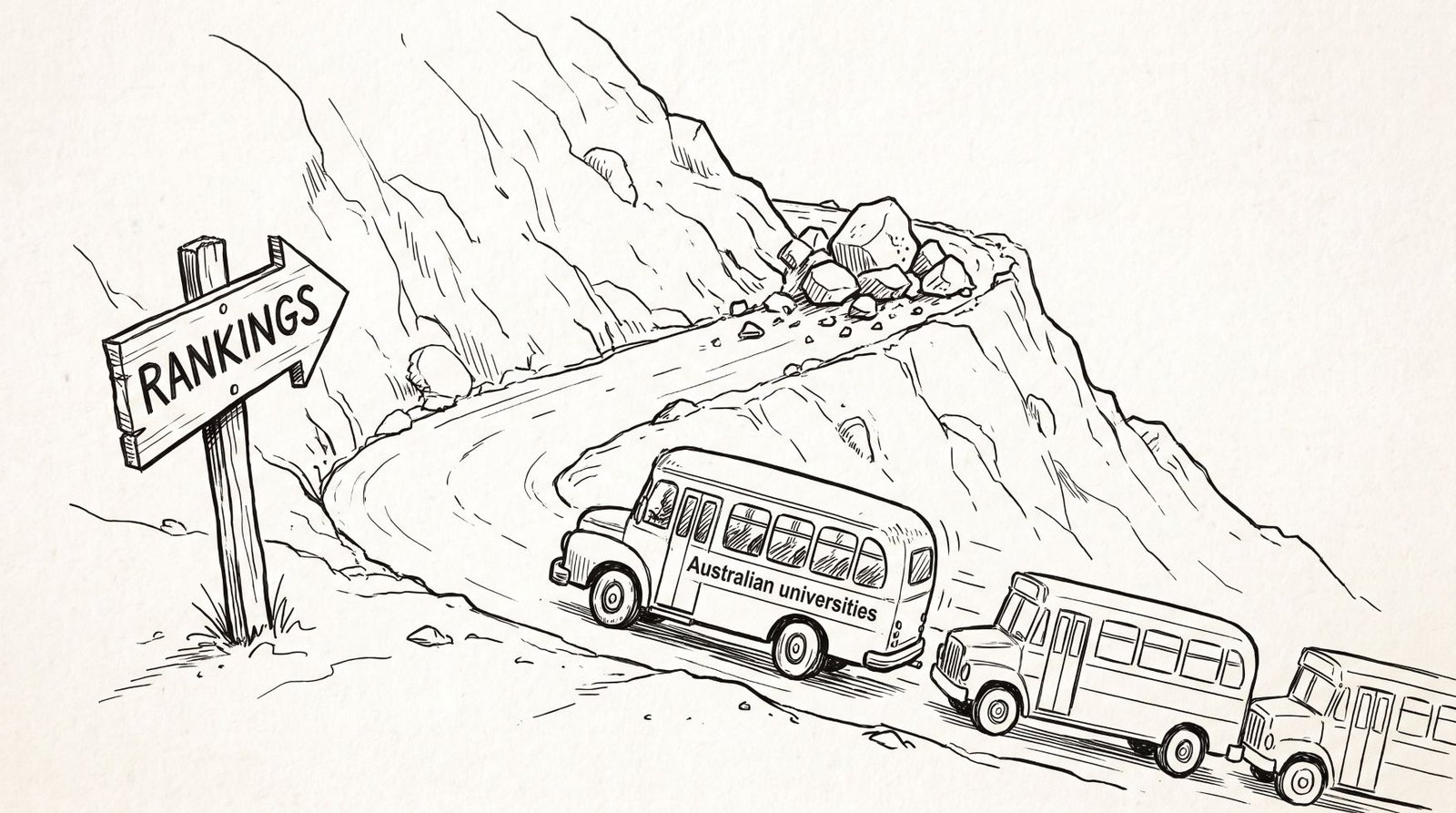
Australia’s performance in the 2026 edition of ShanghaiRanking's Global Ranking of Academic Subjects reflects a system that remains globally competitive. While the overall number of ranked subject listings decreased slightly, the proportion of subjects at Australian universities in the world’s top 100 increased from 36.0% last year to 37.1%.
Australia is becoming more elite and research-intensive with excellence concentrated in fewer disciplines.
ShanghaiRanking released the tenth edition of its ever-expanding subject rankings on 15 September. The Global Ranking of Academic Subjects (GRAS) contains rankings across 57 subject areas, unchanged from last year, and includes more than 1,960 institutions across 92 countries, compared with 1,679 institutions in 2018.
Overall, 39 Australian universities have a published ranking for at least one subject. This year, the total number of Australian listings declined by 25 to 870, the second-lowest result in the past six years.
Last year, I observed that Australia appeared to be maintaining its position (i.e. just plodding along), rather than keeping pace with trendsetters in middle-income countries, particularly across parts of Asia.
Most listings
Melbourne and UQ have the highest number of listings (52 each), followed closely by UNSW with 51. The remaining Go8 institutions, together with UTS and Griffith, round out the top 10 by number of listings.
Top performers
Over the past eight years, the proportion of subjects at Australian universities ranked in the top 100 has ranged from 34.1% (in 2019) to 37.1% this year. In 2026, there are 323 top 100 subject listings, one more than last year.
Of these, 38.1% are in Engineering (down from 40.4% last year) and 29.1% are in Social Sciences (up from 28% last year).
This year, 28 Australian universities have one or more subject listings in the top 100, with UNSW again having the most (39, or 76.5% of its total listings), followed by Sydney (37, or 74.0% of its listings) and Melbourne (36, or 69.2% of its total listings).
Rocky road ahead
Looking ahead, sustaining and strengthening Australia's international standing will require continued attention to research productivity, investment in capability across a broad range of disciplines, responsiveness to evolving workforce demands, and adaptation to rapid technological change.
These challenges are compounded by an increasingly complex and uncertain geostrategic environment.
Across many parts of the world, authoritarianism, nationalism and populism are gaining influence, often accompanied by efforts to undermine trust in higher education institutions, constrain academic expertise, and weaken the independence of agencies responsible for quality assurance, research funding, and regulatory oversight.
At the same time, the multilateral system that has underpinned global cooperation and trade for much of the post-war II era is showing signs of strain. International agreements and institutions are increasingly contested, with implications for educational cooperation and the cross-border exchange of knowledge.
Governments are also adopting a more interventionist approach to higher education, while placing renewed emphasis on national interests, strategic autonomy and economic security, reshaping expectations about the role universities play in society and international engagement.
International collaboration in perspective
These geostrategic tensions are also impacting international collaboration, which have long enabled researchers, institutions, and nations to address shared challenges and accelerate discovery.
One of the most important structural shifts has been the rise of China as a scientific and research powerhouse. Over the past four decades, China has evolved from a relatively marginal participant in international research to a collaborator that rivals the United States across many fields.
For Australia, China has become nearly as important as the United States as a research partner. This reflects both the scale of China’s research expansion and the growing interconnectedness of the two countries’ research systems.
For Australian universities, these shifts present significant challenges. Navigating heightened geopolitical uncertainty, increased competition for talent and research investment, and more fragmented international relationships will require strategic adaptation while maintaining globally connected research and education systems.
Balancing national interests with the benefits of international collaboration is likely one of the defining challenges for the sector over the coming decade.
Domestic policy settings
Australia's domestic policy settings may also create significant challenges for the higher education sector.
High rates of student visa refusals risk reducing international student enrolments, diminishing an important source of university revenue and potentially eroding Australia's reputation as a welcoming and reliable study destination.
Efforts to reduce migration levels may also affect the academic workforce. Australian universities rely heavily on international talent, and lower migration flows could constrain their ability to attract and retain highly skilled academics and researchers, which also reduces international academic mobility and knowledge exchange.
Persistently high living costs increase financial pressure on students and may affect student participation and success, particularly among those from disadvantaged backgrounds.
Collectively, these factors are likely to place further strain on university finances and operations. Operating deficits are becoming increasingly common, limiting institutional flexibility and long-term investment. Universities also face growing difficulties in sustaining research activity in some disciplines as public investment has not kept pace with rising costs, while competitive grant funding often fails to fully account for inflationary pressures.
These pressures are expected to affect several dimensions reflected in global university rankings, including research productivity, quality and impact, industry engagement, international collaboration, and academic and employer reputation.
Put simply, the ability of Australian universities to sustain their historical levels of performance has been under growing pressure over the past three years. If current trends persist and anticipated policy changes proceed as proposed, the relative position of Australian universities in global rankings will weaken further.
Turning challenges into opportunities
Last year, I argued that rather than focusing on the pressures facing the sector, Australia should concentrate on building a more resilient, innovative, and student-centred higher education system.
Regulatory complexity and the administrative burden associated with excessive reporting requirements need to be reduced. Compliance obligations have expanded considerably, diverting resources and staff effort from teaching, research, and community engagement.
At the same time, increasingly risk-averse approaches to governance and decision-making can unintentionally stifle innovation, discourage experimentation, and limit institutional agility.
A better balance between accountability, oversight, and innovation would enable universities to respond more effectively to emerging opportunities, adapt to changing circumstances and pursue new approaches that enhance their educational, research, and societal impact.
Angel Calderon is a higher education global expert.