

Opinion
When it comes to the higher education sector, Western Australia has often been seen as a quiet achiever that, by and large, stays out of the limelight. But in some ways, it has been a leader. As an example, a WA institution was one of only a few to commence larger scale international student recruitment in the 1980s. By today’s standards, this recruitment was small, but it was the start of something big. WA was also ahead of the curve, creating the first of the ‘new universities’ just prior to the Dawkins reforms. The Act creating Curtin was passed in 1986 and Curtin came into existence in 1987, only months before John Dawkins was appointed as the Federal Education Minister.
If managed well, the State can position its universities strongly and support the next stage of WA higher education development. This is going to involve change. Whether that change will include a merger or mergers is the current key focus. One must remember that mergers are intrinsically high-risk activities as the realistic possibility of them being undone if they fail is close to zero.
On 11 October the WA Government announced an expert committee to prepare a business case for a three-way merger of The University of Western Australia, Curtin and Murdoch Universities. Edith Cowan University is exempt.
It is undoubtedly an idea that deserves serious debate and rigorous testing, because the choices made now are likely to be irreversible and will affect the State’s productivity for decades to come.
We have been here before
In the second half of 1988, in the wake of the creation of Curtin and the early stages of the Dawkins reforms, the UWA Senate and the Murdoch Council each voted on a proposed merger of their institutions. By 1989 the State’s Legislative Council had passed legislation that blocked the merger. The lesson is not that mergers cannot work. It is that a process driven from outside, without the governing bodies behind it, will end up being settled in Parliament, not directly by the universities themselves.
The State’s own University Sector Review, led by Professor Sandra Harding and delivered to the Minister in October 2023, took the idea further. It found a merger a viable option, with conditions. It concluded that any proposal must include both UWA and Murdoch, judged that a merger of all four public universities would be overly ambitious, and recommended more work on a merger of UWA with Murdoch, with another option to include Curtin as well. It said success would need significant WA leadership and funding and genuine commitment from the universities themselves. It noted research shows that voluntary mergers are more likely to succeed than involuntary ones. Curtin has said it does not support a forced merger, which makes that point a live one.
The 2023 review was open about benefits and risks. On 2021 figures, non-academic staff spending would have been $28 million to $59 million lower for the three-way option, an illustration and not a forecast. It expected a combined university to rise in the research- based ARWU ranking but fall in the QS and Times Higher Education rankings. It warned of lower student satisfaction at a larger institution and the risk that researchers might leave. It was judged that Curtin, left out of a merger, could continue as a standalone institution, though it was worth considering as a merger participant. This review had a particular focus on size. This is understandable as, by world standards and measured by student numbers, the average Australian public university is large.
In some ways, we have today returned to the position of the late 1980s.
What the Deloitte analysis does and does not show
The only quantified business case for merger so far is the ‘rapid cost-benefit’ analysis that Deloitte delivered to the Government on 26 November 2025. It deserves credit as a first attempt to put numbers on the options. It put the present-value cost at $175 million for UWA with Murdoch, $450 million for UWA with Curtin and $522 million for all three, and reported benefit-cost ratios of about 4 to 27, suggesting that quite small improvements in performance would pay for a merger. However, it does appear to leave out one or more uniquely WA factors.
More broadly, the analysis does not show that a merger would deliver those improvements. It asks how small an improvement would be needed to pay for one. In its scenarios, the lower-performing universities close 30, 50 or 70 % of the gap to UWA on one measure at a time, such as completion rates, research spending per academic or international fees, while UWA is held constant.
Five features of Deloitte’s report matter. First, the three options were chosen by the Government’s Investigation Committee, not by Deloitte, and the report says it does not seek to reargue whether a merger is the right remedy for the problems described.
Second, UWA is in every option studied and is the benchmark the others are assumed to approach. That makes UWA the unstated premise of Deloitte’s analysis, although the 2023 review stated this outright, and it means the analysis cannot show whether a merger is better with UWA, without it, or not at all. Third, the Deloitte analysis appears to presume that there are no benefits in leaving UWA untouched and no benefits that UWA can alone harvest by internal improvements within a standalone research- intensive mid-sized university. Fourth, each option is compared with a frozen no-merger base, no alternative such as shared services or research integration is tested, and disruption, which the report’s own charts put at between about one and a half and three times the cost of the merger, and more than twice for the three-way merger, is netted from the benefits instead of being counted as a cost. Fifth, it assumes no savings. That is cautious, but it means the efficiency argument at the heart of the pro-merger case is not tested. Thus far, the analysis also includes no State funding.
None of this means that a merger cannot create value or should not, in some form, take place. It does mean that the full business case has considerable work to do.
What we know
While there are clear similarities, WA’s universities also differ from one another, and that is part of their strength. That does not mean there is no arguable case that, combined, they could not be forged into a formidable institution of enormous scale. An objective, evidence-based case is crucial, including the evidence on economies, and potentially diseconomies, of scale and scope.
UWA owes its existence to the 1911 Act that followed a Royal Commission chaired by Winthrop Hackett, and a century of endowment and philanthropy has sustained it. Some of that endowment became large tracts of land. The pine plantation that became the suburbs of Murdoch and Winthrop was developed in the late 1970s, and many of its streets take their names from UWA’s 1978 internal phone directory. One of them, as it happens, carries the surname of the first author of this paper.
Curtin was created as a very different kind of university. In 1986 the State Parliament legislated to turn the Western Australian Institute of Technology into Curtin University of Technology, the first of the “new universities” that arose in the late 1980s. From the start its postal address, GPO Box U1987, marked it out as a university despite being listed as a ‘College of Advanced Education’ by the Federal Government.
Curtin was also bold on the world stage, one of only a few to recruit international students on a large scale in the 1980s. The Commonwealth has now imposed international student caps, and the model that helped build the sector is under pressure.
The three universities differ sharply in their student mix. About two-thirds of UWA’s student load in 2024 was domestic, marginally more than the University of Adelaide and the highest share in the Group of Eight. Adelaide’s merger has likely changed that.
Murdoch now teaches more overseas than domestic students, and Curtin has a large international base. Those differences shape each university’s costs, risks and priorities.
Few, if any, other Australian universities have benefited as UWA has from historic philanthropy. For decades the “Number 2 account” gave UWA discretionary funding that was the envy of many.
The State’s 2023 review described an environment of “hyper-competition between universities” that “detracts from, rather than enhances, the State’s interests”. Competition can indeed run that way. When universities cannot achieve adequate scale and suffer from diseconomies of small scale, or cannot charge more, they can hold teaching costs down and spend on marketing and international student recruitment.
International fees can then cross-subsidise research, because a stronger research profile lifts global rankings, and rankings help recruit more international students. The cycle rewards visibility, not quality in the classroom.
Competition could instead be a race to the top, if better teaching were rewarded with more revenue, but the Commonwealth sets domestic funding and the student contribution. The Australian Tertiary Education Commission’s Working Group on Higher Education Costing and Pricing, now under way, may in time consider arguments about funding that impact on the current discussions. And elsewhere, competition often produces specialist institutions. In Australia it has produced comprehensive universities, each doing most things. We have no MIT or Caltech, which is likely an effect of the Commonwealth funding model, not of the inherent undesirability of a smaller specialist university.
The evidence on institutional size is mixed, with both economies and diseconomies of scale. One element of this, administrative economies of scale, was discussed in Future Campus this week by researchers Peter Woelert and Gwilym Croucher. The balance over overall institutional economies and diseconomies of scale, including the academic endeavours of teaching and of research, depends on which universities are joined in a merger and how.
Currently, WA’s universities perform well on how efficiently they turn spending into teaching and research. The Higher Education and Research Group’s Research and Education Efficiency Frontier (REEF) has shown that, over the past several years, UWA, Curtin, Murdoch and ECU have all been strong performers in terms of productivity and overall value for money. Those successes are worth protecting. On average, WA’s institutions outperform the average in every other state.
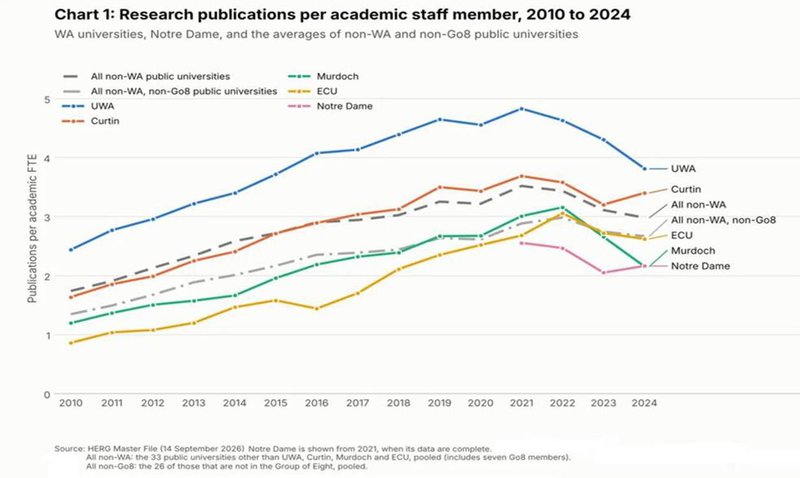
WA’s research output per equivalent full-time staff member is impressive by national standards, as the chart below shows. On this measure, UWA outperforms the others in the research-intensive Group of Eight, and Curtin also performs strongly against that same benchmark.
The recent South Australia merger offers some evidence of opportunity and a note of caution. The new Adelaide University opened in January 2026 with reportedly $464.5 million of State support. Its business case assumed about 6,000 more international students by 2034. In 2026 new international enrolments were about 40 % below target, and the university projects a revenue shortfall of about $90 million. Policy set in Canberra changed after the business case was written. Policy changes are a risk factor in institutional merger discussions.
What we do not know
We do not have a full understanding of what “hyper-competition” costs. We need evidence on where duplication occurs, how much it wastes and how much a merger would save. Student outcomes, measured by six-year completion rates, are cited as part of the case for a merger. But Murdoch’s Vice-Chancellor, Professor Andrew Deeks,
writing on 14 October, has called Deloitte’s assumption that students who have not finished within six years do not finish at all “a fundamental error”, noting that many of Murdoch’s mature-age, part-time students do finish, only later. We need an objective, evidence-based analysis. There should be no winners and losers here. It should be the WA community and economy that wins. In decades to come, the State’s productivity will be impacted by the choices made now.
We do not know whether UWA’s performance results would hold in a combined university, which the Deloitte analysis assumes by holding UWA constant. Both the 2023 review and the 2025 feasibility study left ECU out, describing it as “clearly differentiated”. But if “hyper-competition” among WA’s universities is the reason for a merger, why is ECU out of the picture? And should a merger not proceed, “hyper-competition” could still be managed in other ways, including less intrusive arrangements that encourage collaboration across all four universities.
Earlier we mentioned the State’s productivity. As it so happens, Australia’s productivity growth has largely stalled, and this has been a topic of serious concern and debate nationally. There are researchers at all four public universities in WA who work in fields related to productivity; could there not be a structure that brings all this work together in ways that are collaborative?
We do not know whether WA receives proportionally less research funding than it ‘should’, though the 2023 review spoke of a continually falling share. The review put the four public universities’ combined research income in 2021 at $425 million, less than the
$441.5 million the University of Queensland earned on its own. But the unasked question is: would a merger improve WA’s funding case in Canberra, or would a larger institution simply be a larger (underfunded) claimant?
And we do not know whether a merger would change behaviour. Combining three comprehensive universities into one larger one would not alter the funding rules that made them alike. Where the gains and losses from scale and scope would fall, and who pays the transition costs, are open questions. The Premier has said more work is needed on whether the universities could fund the reform themselves. And if WA university land were one way to meet those costs, could the same land not fund development without a merger?
What the business case could do for Western Australia
Ideally, the business case needs to test each option separately: the three-way merger, each two-way merger including Curtin with Murdoch, cases with and without UWA, no merger, and less invasive alternatives such as shared services or deeper research collaboration. It needs to show disruption as a cost and savings net of integration costs, say who pays, and test its results against less favourable outcomes. It should disclose its assumptions, show results as ranges rather than single points (the evidence is not precise enough for point estimates) and state plainly what is not known or cannot be measured. It should fully explain the exemption of ECU, protect donor intent and set a baseline now, so that any gains can be measured later. And, as the 2023 State review recognised, it should bring the universities to the table, because mergers the institutions want are the ones more likely to work.
WA Education Minister Tony Buti calls this a once-in-a-generation opportunity. He is right, and that is why it should be decided on the evidence.
Keith Houghton is an alumnus of UWA and is Chief Academic Strategist at the Higher Education and Research Group (HERG).
Christine Jubb is a Project Director of HERG.