

Jason Clare today becomes the equal longest-serving Federal Education Minister in Australian history – and will step to the top of the portfolio’s longevity podium tomorrow.
Mr Clare shares today’s milestone with renowned, sometimes controversial reformer John Dawkins, another hero of the Labor movement.
Mr Clare was appointed Education Minister in the Albanese Government on 1 June 2022 and today marks his 1,618th day in office.
While there is no word whether cake or Australian sparkling wine will be wheeled into the Ministerial suite at smoko time this morning, it will clearly be a day of reflection on his legacy to date – both for the Minister and the 42 Vice-Chancellors (and acting VCs) that he has attempted to bring to heel with an avalanche of legislation and regulation during his tenure.
While no-one was willing to publicly fill out an anniversary report card just yet, it is inevitable that historians will compare the Clare era with the Dawkins revolution – as two leaders who set out to drive significant change.
A National Priority
Education was recognised first as a national priority by Bob Menzies, who appointed John Gorton as Minister-in-charge of Commonwealth Activities in Education and Research under the Prime Minister on 18 December 1963, and then as the inaugural Minister for Education and Science, from 14 December 1966 to 28 February 1968.
Mr Gorton’s oversight of Education across the two roles spanned 1534 days, although only 442 days as Education Minister. Nonetheless, the establishment of the Education portfolio under Menzies marked the first time it had been identified as a priority area for the Australian Government and also signalled the establishment of the Commonwealth Department of Education and Science.
Gorton began the tradition of government intervention – expanding scholarship numbers and enrolments while overseeing the creation of the Canberra College of Advanced Education (now University of Canberra).
The Dawkins Era
John Dawkins served as Education Minister in the Hawke and Keating Governments from 24 July 1987 to 27 December 1991, when he was promoted to the loftier post of Treasurer under Paul Keating.
During his time as Education Minister Mr Dawkins was passionate about improving productivity, forcing mergers of universities and colleges of advanced education, establishing the University of Ballarat (now Federation U), the University of the Sunshine Coast and Southern Cross University and introducing HECS fees.
The move to widen access and force mergers and introduce more financial measurement and scrutiny of universities prompted some bitter opposition at the time, and some of the attempts at mergers failed, but regardless of ideology, the Dawkins era is widely agreed to be significant turning point for tertiary education in Australia.
The ClareVolution – So Far
Mr Clare has adopted the vision of the Accord, rooted out and showcased a myriad of failings in the post-school sector, locked in big wins in funding for public schools and introduced reforms across the life course in education.
His most dramatic moves have been in the tertiary sector, stepping away from a market-based system to a far more centralised, managed approach where he and his multitude of agencies and overseers hold far more levers, with a command and control style theme.
There is no doubt that Mr Clare has embarked upon a welter of reforms with the ambition for generational change. Whether his many generals have the data, organisational savvy and willingness to look at public want and demand-side dynamics as opposed to seeking to control the system from within the Departmental bunker will probably determine whether the ClareVolution is branded a success or failure.
Jason Clare’s Top Hits
Key milestones for Mr Clare in the Tertiary space include:
- A new system: Introduction of a new management and funding system for higher education – bringing in centralised control of the sector, managed growth and needs-based funding
- An ambitious manager: Establishment of the Australian Tertiary Education Commission to directly manage higher education
- A formidable enforcer: Significantly strengthening the regulatory powers of Tertiary Education Quality Standards Agency (TEQSA)
- King of JRG: Mr Clare has presided over the failed Job Ready Graduates scheme for three times as long as the Coalition. Dan Tehan introduced the scheme, with effect from 1 January 2021 and presided over it for just 516 days, before Mr Clare took the helm. The Government has picked up more than $1 b extra from students and saved multi-billions in payments to universities with the JRG has been in place.
- 20% HECS discount – valued at around $16b, the one-off 20% HECSHELP and VET student loan cut in 2025 helped about 3 millions Australians after the Government recognised indexation had been too high.
- One Uni Merged, more proposed: the University of South Australia and Adelaide are no more, morphed into Adelaide University and three more institutions in WA are currently under review in a highly public State Government attempt at a further merger. Further mergers are rumoured, as some smaller institutions struggle with heavy compliance and plummeting international enrolments.
- International Welcome Mat Removed: Student visas are rarer and pricier with pressure from across Parliament to cut international enrolment numbers in a bid to be seen to respond to a national backlash against immigration. International student numbers grew substantially in the first years of Mr Clare’s watch before onshore enrolment growth became politically unpalatable.
- Compliance Conquest: There are now more than 300 rules, regulations and laws that HE institutions need to report on or respond to. Mr Clare has responded to a cavalcade of highly public institutional failures by imposing a massive range of regulation. The challenge now is to demonstrate that the Department and Overseers can do better.
Mr Clare’s era appears far from over – and many others will identify reforms that they believe belong on the Minister’s showreel. Trivia buffs will note that Brendan Nelson is now in the Bronze Medal position for Fed Ed Min longevity at 1524 days (November 2001-Jan 2006).
A quick analysis of Mr Clare’s linguistic legacy is presented below, based on word search of the media releases and speeches on his Ministerial website as at 10am on 2 November 2026.
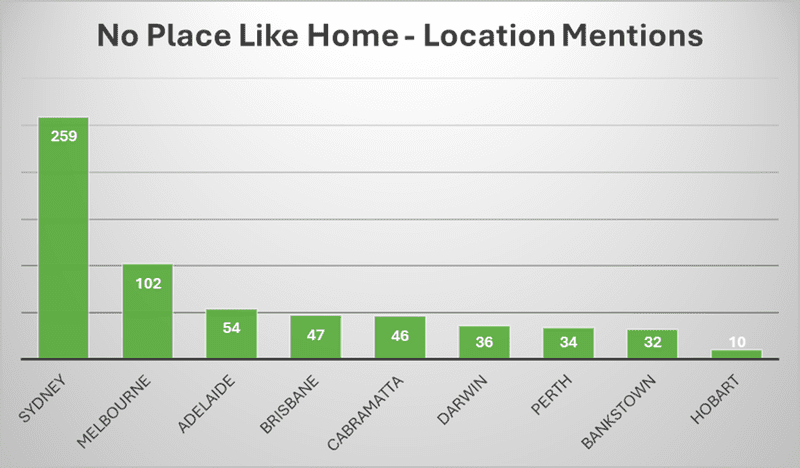
The Minister for Education across Australia maintains a distinctively Sydney-centric tone is his public utterances. Mr Clare has mentioned Sydney at more than twice the rate of Melbourne, and 20 times more than Hobart.
Mr Clare’s oft-retold origin story growing up in Western Sydney has contributed to the overwhelming focus on talking about his hometown, with the inspiring tale of the dizzy heights attained by the boy schooled in Cabramatta helping to explain why the suburb has been mentioned more often than Darwin, Perth and Hobart.
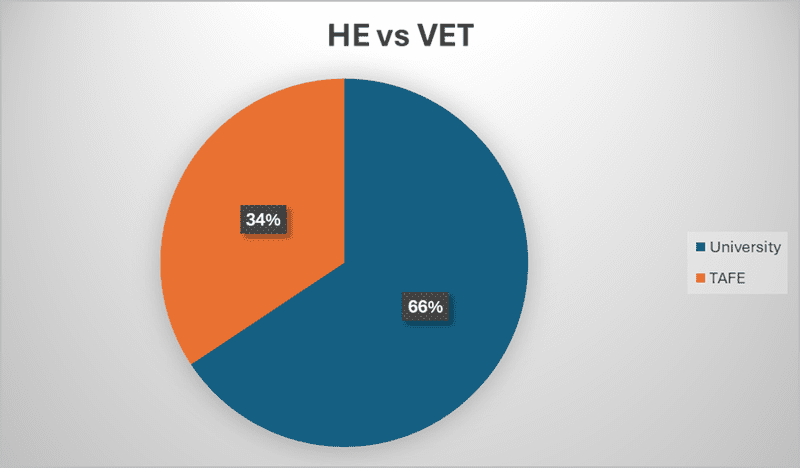
With a Skills Minister sidekick it is unsurprising that HE references (557) are almost twice the rate of VET references (291). Reflecting the challenges of bringing the two sectors together, the terms Harmonisation and Harmonise rank a total of just 14 mentions.
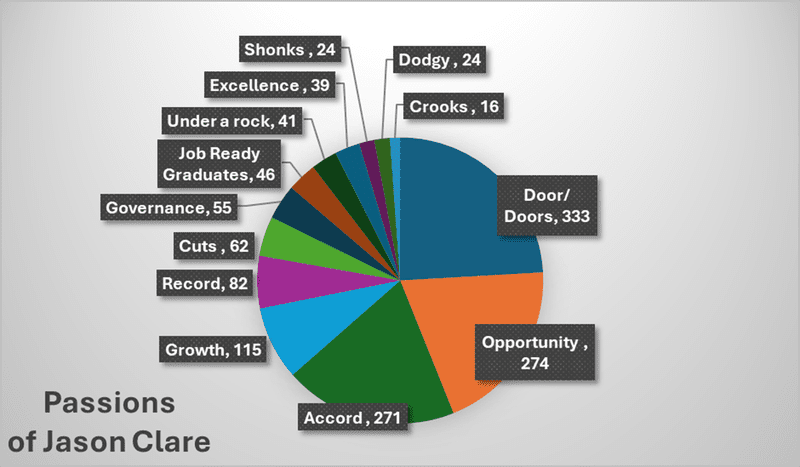
The Passions of the Education Minister shine through with certain phrases. Charting his course to be a reformer focused on increasing participation and improving equity, the founding vision of the Accord (271 mentions) appears to be related to his fascination with door/doors – even including the term in his latest funding reform Bill, topping the favourite phrases with 333 mentions over the course of his Ministerial career.
Reflecting his willingness to shine a light on the problems lurking within the sector, the memorable ‘shonks’ appears 24 times (14 more references than he has made to Tasmania’s capital over the past four years), as well as 41 references to ‘under a rock’ 16 to ‘crooks’ and 55 to ‘governance.’
An enthusiasm for milestones has propelled ‘record’ to 82 references and ‘growth’ to 115 references, while a reluctance to shine a light on the ongoing maintenance of the Coalition’s failed fee structure has meant ‘Job Ready Graduates’ has only been mentioned 46 times.
One last, important reference – Mr Clare has celebrated and recognised a key teacher in his life, Mrs Fry 21 times, in a repeated and valuable endorsement of the impact of great teachers.This appears as an authentic elevation and endorsement of an underappreciated profession.
The Challenge Ahead
Claiming a legacy is undoubtedly harder than claiming longevity. With VET numbers down, total university enrolments down, an ongoing fiscal addiction to the Government revenue upside of the JRG scheme, a battered economy, political adversaries pressuring international enrolments to be lower, cost of living fatigue and increasing public questions over the value proposition of tertiary education in the face of AI, Mr Clare faces intense challenges to his Accord-based goals.
Finding a seat and enough teachers for a million extra Australians in Australia's tertiary system over the next 23 years sounds hard – convincing them to actually enrol while enduring massive black hole in demand-side market intelligence makes Everest look like a day hike.
As the Minister directly responsible for ANU, he will be acutely aware of governance and fiscal sustainability challenges already present in the sector.
The future of his legacy now lies in the hands of the hundreds of staff of ATEC, TEQSA, the Department and other agents of management, regulation and control, who have been handed a multitude of levers to centrally control the sector.