
Australia boasts a diverse and dynamic higher education system, with over 1.6 million students as of 2023.
Remarkably, nearly 1.5 million of them are enrolled in universities that are part of Universities Australia (UA), and around 30% of them are international students, underscoring the sector’s excellence and global standing.
However, the stability and the future growth of Australian universities are threatened by a dual challenge. The first challenge stems from a very significant but rarely noticed decline in the population aged 18 to 25 years. The second challenge arises from a decision by the federal government to cap the number of visas granted to international students that has already sparked concerns as the international students’ admission fees is a major source of revenue for the entire university sector.
The two challenges mentioned above pose a considerable threat to sustaining Australia’s higher education sector. Referring to a similar situation in the United States, Bruce Mackh describes the projected decline in domestic higher education student enrolment from 2025 as “the enrolment cliff,” attributing this trend primarily to declining birth rates and shifting demographics. Mackh also criticises the higher education sector for maintaining its usual practices and status quo, despite clear evidence of a declining birth rate, and cautions that without strategic intervention, universities will face significant challenges in maintaining enrolment.
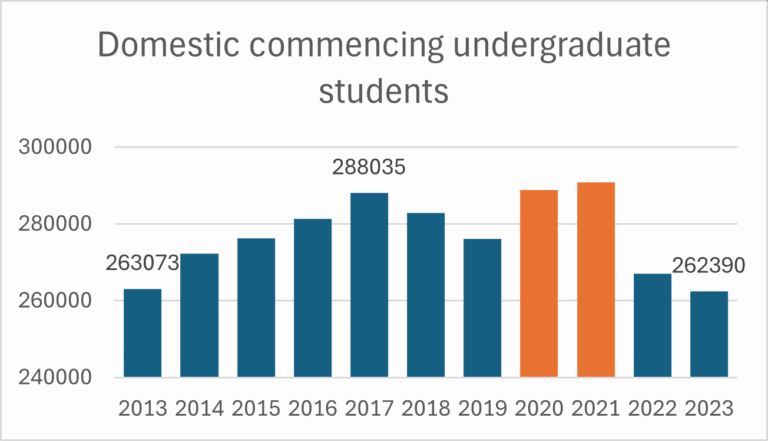
Higher education enrolment data for 2022 in Australia showed a 3.2% decline in commencing domestic students, the primary source for higher education, dropping from 1,602,573 in 2021 to 1,555,411 in 2022. The decline is particularly significant among undergraduate students, showing an 8.2% decrease. The decline in commencing domestic students continued during the 2022-23 period (1.8 per cent decline – from 267,104 in 2022 to 262,390 in 2023).
As shown in Figure 1, the total number of commencing undergraduate students in 2023 has dropped even further compared to a decade ago, and this decline is expected to continue. COVID-19 pandemic-related travel restrictions and limited employment opportunities led to some increase in 2020 and 2021, however once the situation returned to normal, the declining trend resumed.
Figure 1
Data source: Australian Government 2024
This downward trend, coupled with an overall demographic shift, highlights the growing challenge of maintaining domestic student numbers in Australian universities. As the latest budget predicts a huge fall in international migration in future years to come, including a decline of 100,000 in this financial year, Shadow Treasurer Angus Taylor has announced international student numbers will be lower than what is now should the Coalition win the upcoming election.
The situation for higher education sector would be even more challenging. The Coalition has also promised to limit the number of international students able to commence study in Australian institutions to 240,000 each year — a figure that is 30,000 less than Labor proposed last year and 80,000 less than our current intake of international students every year.
It will also seek to mandate that no more than about a quarter of students at public universities are enrolled from overseas from next year.
It should be noted that not all 18-25 years olds in Australia enrol in tertiary education. As an indication of what proportion of the population of this age-group go for tertiary education, one may look at the statistics on recent study published by the Australian Bureau of Statistics (ABS) in May 2024, according to which 83.2 % of the population aged 15-19 years, 44% of the population aged 20-24 years and 16.5% of the population aged 25-29 years is enrolled in higher education as of 2024. While it would not be correct to take the average of these three figures as an estimate of the percentage of population aged 18-25 years enrolled in tertiary education, it might be safe to infer that less than 50% of the 18-25 years olds are enrolled in tertiary education.
Using data from the Australian Bureau of Statistics, we have analysed three different scenarios for Australia’s population aged 18-25 years, with and without the international migration component of this age-group. The scenarios are:
Scenario 1: Zero net overseas migration (an extreme policy scenario)
We have adopted the Australian Bureau of Statistics’ (ABS) zero Net Overseas Migration (NOM) scenario to illustrate the potential availability of individuals aged 18–25 as a domestic pool for higher education enrolments in the absence of overseas migration. This NOM assumption is used in conjunction with the medium fertility and medium life expectancy series.
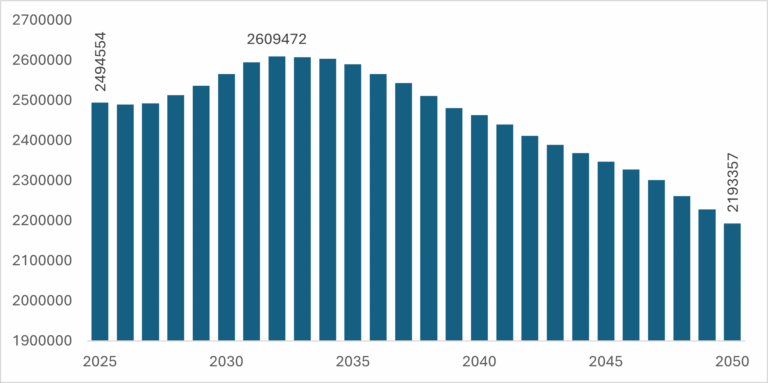
Under this most conservative scenario, where net overseas migration for this age group is assumed to be zero, the local Australian population within this cohort is projected to grow over the next seven years, peaking at nearly 2.6 million by 2032 (Figure 2).
The increase over the next seven years is driven by a higher relative birth rate from two decades ago, as well as the overseas migration of parents with young children. From that point, a steady decline is expected, with the population falling to approximately 2.2 million by 2050 which means around a total 300,000 less Australian population in this group in next 25 years.
While the assumption of zero net overseas migration is hypothetical, the data presented in Figure 2 accurately reflects the actual number of local Australians in this age group. This decline in Australia’s population is primarily due to a falling birth rate (ABS, 2023), with a smaller contribution from mortality within this age group.
Figure 2: Trend in local population in the age group 18-25 assuming zero overseas migration
Source: .Stat Data Explorer (BETA) • Population Projections, Australia, 2022-2071
Scenario 2: Alternative assumptions
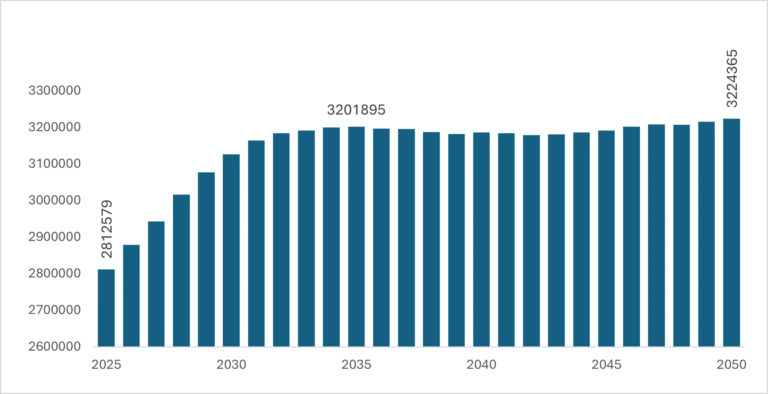
If the overseas migration trend for 18-25 age group continues to be at a moderate 225,000 persons per annum (similar to levels across 2010-19), then with the increase in local population, the population in this group will continue to grow until the year 2035 and will remain stable from there until 2050 (Figure 3).
This is probably the most ideal scenario for sustaining the Australian higher education sector.
Figure 3: Trend in local population in the age group 18-25 assuming medium overseas migration
Source: .Stat Data Explorer (BETA) • Population Projections, Australia, 2022-2071
Scenario 3: Conservative policy
The third scenario uses the ABS’ low NOM projection scenario of 175,000 per annum, in combination with the same fertility and mortality assumptions. If immigration policy in line with this trajectory were to be adopted, such as through heavy capping of international students, there would be around 205,000 less people compared to the medium in this age cohort by 2050.
A challenge ahead
The two challenges for Australian universities that have been mentioned above are the projected decline in the population aged 18-25 years, the main pool of tertiary students in Australia and secondly, the impending cap on the number of international student visas starting 2025. A third “challenge” that may be added to the discussion is that less than 50% of the 18–25-year-olds enrol in tertiary education, the rest enrolling in vocational education and training (VET), other forms of education/training or working.
Therefore, in order to increase and maintain the number of students enrolled in tertiary education at Australian universities, one has to tackle the above-mentioned challenges. First, let us consider increasing the size of the population aged 18-25 years. This would require a rise in the birth rate which would be well-nigh impossible under the continuing regime in Australia of the key socio-economic changes that occurred in Europe’s Second Demographic Transition described by van de Kaa (2002).
Even if it were possible to increase the birth rate against all odds, it would take at least 18-20 years before these births entered the cohort of 18–25-year-olds. Therefore, this solution offers little help in augmenting university enrolments as of now. The second option would be to boost the number of international students, which would not only help maintain university enrolments at least at the current level but also help increase tertiary education funds, thereby allowing investments in teaching and research. It would also help culturally enrich the tertiary education community in Australia. The third solution could be to increase tertiary education enrolment rates beyond the current rates of below 50%, without unduly curtailing the much-needed VET enrolments.
The cap on the number of international student visas is reportedly introduced in order to ease the housing crisis in Australia. However, research conducted by Mu and Soong (2025) has busted this myth. Further, as reported in The Conversation estimates from the Australian Bureau of Statistics show that international education contributes $51 billion to the Australian economy, and higher education institutions receive almost $16 billion in tuition fees from international students, which match the income that the universities receive from the government for domestic students.
Given the near impossibility of raising Australia’s birth rates and the long waiting period before any rise in birth rates coming to fruition, combined with the impracticability of increasing tertiary enrolment rates to any appreciable level, the only short to medium term solution to undo the shrinking future of Australian universities appears to be to increase the enrolment of overseas students.
Professor Udoy Saikia, Associate Professor Gouranga Dasvarma and Christopher Hogan are from the College of Humanities, Arts and Social Sciences at Flinders University. They research in the areas of population studies and demography.