
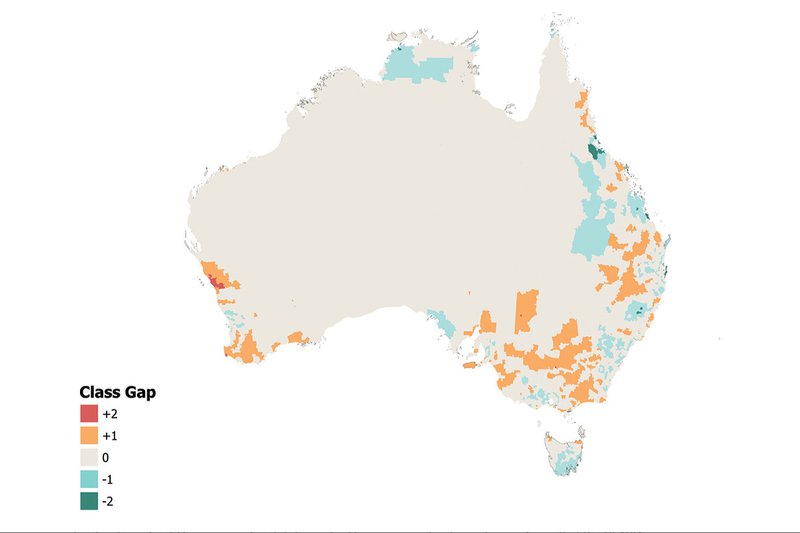
A new map of higher education disadvantage has been developed by researchers, establishing a new metric to identify underserved communities.
Historically, HE geographic disadvantage has been measured by measures of remoteness from services and Remoteness Areas defined by the Australian Bureau of Statistics, but this new system instead focuses on the far more relevant measure of access to campuses via road.
The Higher Education Accessibility/Remoteness Index has been developed by Vince Gingoyon, Varun Mehta and Ian Li from Australian Centre for Student Equity and Success (ACSES).
The index is built on the distance of more than 12,000 localities to 267 university campuses around Australia, helping to define a new Higher Education Remoteness Areas (HERA).
The map above shows difference between existing approaches based on ABS data compared to the new HERA's – with differences particularly pronounced in the NT (where campuses are fewer). The index was also useful in identifying fringe urban areas where campus access was difficult – and could be used to plan future study hub locations, the authors said.
The research is particularly significant given the Government’s current approach to use money purportedly aiming to address regional disadvantage by giving money to historically-underfunded regional campuses. This approach provides long-overdue funding to assist regional campuses, but does little for regional students who don’t live near them.
“Current operational definitions can misidentify geographical disadvantage among students,” the authors write.
“This needs to be considered in proposals to increase Australian government support for regional and remote participation, including policies to provide additional funding for regional campuses.”
“The central policy implications associated with HEARIA adoption relate to how student-level geographic disadvantage should be measured and distinguished from campus-level remoteness.”
The authors articulate the issues of failing to support regional students with the current Needs Based Funding (NBF) model.
“In its current design, the NBF funding component dedicated to the geographically disadvantaged cohort is tied to the remoteness of the campus location, rather than the students themselves.
“While this serves to address the higher cost of learning and teaching delivery at regional campuses, NBF is not aimed at regional or remote student level support specifically.
“Under this approach, students from regional and remote areas who study at metropolitan campuses attract no additional funding if they are not from a low socioeconomic status background (The University of Melbourne, 2024), with the possibility that the NBF model strengthens higher education infrastructure in well-established regional locations without addressing the barriers contributing to individual disadvantage elsewhere (DoE, 2019).”
The HEARIA model could be further developed to connect to other data and develop a more nuanced and targeted approach to addressing regional disadvantage, the authors said.