

Almost half of Australian academics polled in a new survey reported dissatisfaction with workload and less than a third said they would recommend academia as a career to others.
The report lays bare issues frequently arising in anecdotal commentary around roles and culture in the higher education sector – a gulf between senior management and staff, concern about lack of clarity of institutional strategy and direction and increasing challenges from workload, employment precarity, lack of recognition and frustration over career progression.
On the positive side, just one in five were dissatisfied with their pay, with 65% declaring they were satisfied or highly satisfied by their financial compensation – and almost three quarters (74%) of respondents valued strong relationships with their colleagues and immediate supervisors. This aligns with other research indicating staff tend to affiliate and feel comfortable with their teams, but distant and unrecognised by senior executives.
A new publication by Jess Harris from the University of Newcastle, Kathleen Smithers from UNSW, Sarah Gurr from Charles Sturt and Newcastle’s Sean Groth provides preliminary insights from a survey of more than 530 academics across Australia, seeking to understand their perceptions of their work. The team also carried out interviews with 38 academics to explore key insights.
“Overall, this preliminary analysis highlighted a sector under significant strain. Participants reported their ongoing commitment to teaching, research and supporting students in the face of overwhelming workload pressures,” the researchers write.
“Across the sector, academics are grappling with structural and cultural challenges that impact their satisfaction with work, leading to issues of staff retention.”
Interestingly, while 48.5% of respondents were dissatisfied with workload, more than 30% said they were satisfied. This disparity in itself is worthy of a thesis. Are those happy with their workload shirkers; long-term level Es in contented stasis; or just efficient? Are those who are unhappy the shirkers; long-term level Bs and Cs waiting for the Es to finally retire, or the uncomplaining ones who keep getting lumbered with all the unpopular gigs?
The report itself is an exemplar in sector communication – accessible, quickly digestible and evidence-laden. Participants made a range of recommendations to improve leadership and culture, noting a range of issues with promotional systems, race and gender-based discrimination and identified interlocking challenges confronting the sector – with public distrust and funding shortfalls perceived to be driving workloads.
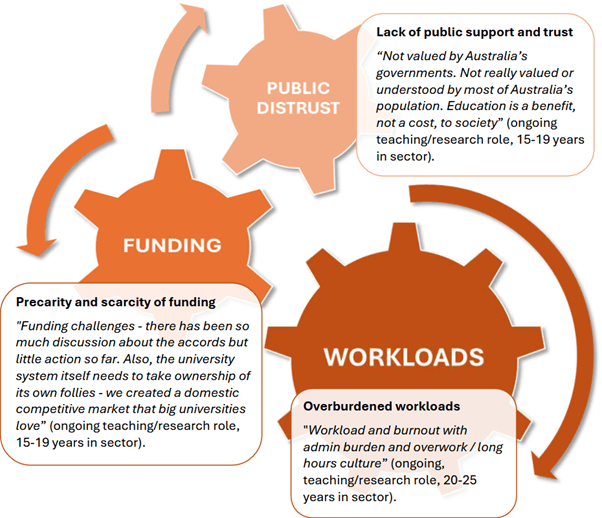
Source: Perceptions of Academic Work in Australia Preliminary Report
“Academic staff expressed concern around the changing nature of their workload, not just that it was too much, but that the rising layers of administration and increased administrative tasks were adding to workload creep,” Dr Smithers explained.
“Tasks that might previously have been handled through a central unit or professional staff, such as timetable allocations etc., were being pushed onto academics as universities cut costs and restructured. It is not just about the amount of workload, but the changing nature of tasks. As one academic stated: "Continual pushing back of admin, we now get 'how to' guides on everything from digitising readings to contracting casual academics".”
The survey also provided insights into perceptions of leadership issues.
“There were a multitude of comments around the concept of fly in fly out leadership, particularly for those at regional universities,” Dr Smithers said.
“Many expressed they felt senior executive were taking positions, implementing change, then leaving before the implications of the change could be measured or evaluated.”