
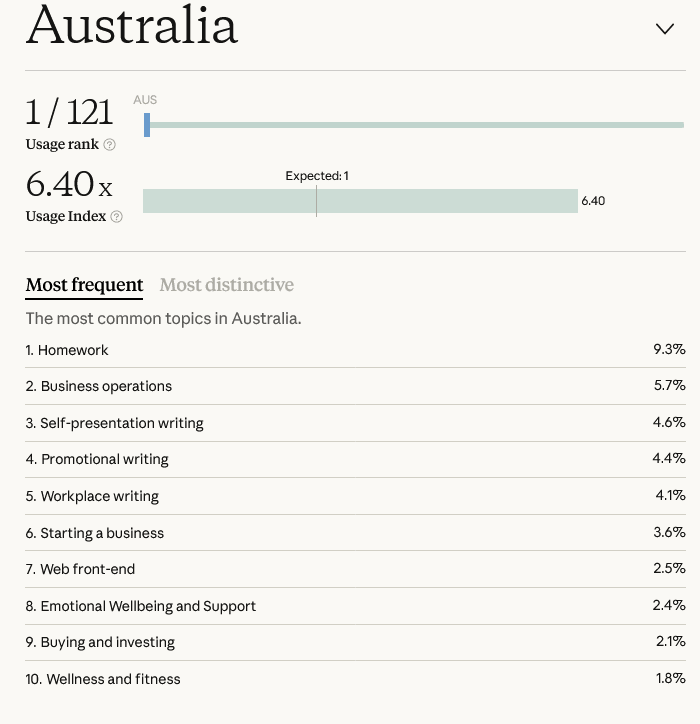
Australians use Claude more than any other nation on Earth, and homework tops the list of uses, by a fair margin.
Anthropic’s Economic Index report shows that Australians used their AI more than any other nation, with the most frequent usage being for homework (9.3%), well ahead of the next highest use category, business operations (5.7%).
In contrast, homework represented only 5% of the usage of Singaporeans, the world #2 in Claude usage and 6.2% for the Swiss, who came in at the bronze medal position. Homework topped the charts for usage in all top 10 countries, with Norway the highest in the group, with 10.4% of uses being for homework. In contrast, ‘business operations’ led Claude usage in Japan, with homework only accounting for 2.5% of usage.
While some commentators are quick to conflate student AI usage with cheating, a little more context is required before dashing to the barricades.
While homework accounts for just under one in 10 requests from Australians, work-related usage is higher overall when categories such as ‘business operations’, ‘promotional writing’, ‘workplace writing’, ‘starting a business’ and ‘web front end’ are combined they add up to more than 22%.
The report does not tell us whether AI is being used to supplement existing teaching; to replace inadequate teaching; to cheat; or to inform. Increased AI usage for legitimate study purposes would make this ranking a major positive for Australia. Increased AI usage for cheating would not.
Epistemic Risks of AI
The Anthropic report emerged just weeks after a new paper, AI Epistemic Risks: Emerging Mechanisms & Evidence presented insights into, “epistemic risks — threats to humanity's collective capacity to know things accurately, reason well, form beliefs, and maintain a healthy information environment.”
The paper, by 30 academics from around the world, proposes that the risk of AI has introduced a new class of risk to human knowledge, arising “from AI's integration into the infrastructure through which individuals and societies think, form beliefs, and make sense of the world together.” The paper is explicit that it is not a forecast of cognitive decline, but an exploration of risk factors that organisations will need to consider to avoid it.
“Humanity's ability to navigate AI and non-AI risks alike may depend on how epistemically resilient our institutions are. It may be critical to act before that capacity is eroded,” the authors said.
Are students mainly cheating or using AI to study better?
So – is Anthropic’s AI corroding the cognition of a generation of cheats, or are students recognising the power of AI tutelage to learn smarter and faster?
The answer, in the absence of deeper data on intention, usage and outcome, is currently unknown. This void on the one hand provides an opportunity for AI haters to claim a pyrrhic victory as they seek to chain tertiary students to paper-based exams on rickety exam desks that remind them of their youth; and on the other, allows AI acolytes to dismiss concerns as a rearguard action by neo-luddites.
In between those two vectors, we asked a range of Australian thought leaders for their perspectives.
UNSW’s Deborah Lupton said there was a lot of researching indicating the impacts of AI.
“This is just embarrassing, Australia! According to Anthropic, we are the highest users of their services globally. And what is the main use? Homework. Our young people’s brains are being rotted,” Professor Lupton wrote.
Curtin U’s Mollie Dollinger, a national thought leader around use of AI in aspects of learning and teaching said more detail was required to understand the implications.
Professor Dollinger said she needed further insight as to whether, "this is cognitive offloading, or whether it is students working through difficult concepts, pressure testing their arguments, and using AI to clean up their writing. The data does not tell us that, and that is what we need to keep unpacking as a sector.”
Deakin U's Margaret Bearman said the percentage of students doing homework was broadly in line with many other nations.
"It matched with my understanding that Australia is generally an early adopter of technology," Professor Bearman said.
"My next thought is there is use and use. We have no idea what homework means. It would be great to know more."
University of Queensland expert in technology and learning Jason Lodge said the data prompted many questions.
"The one thing that has become clear to me this year, as I've looked at what is happening across the rest of the world, is that we are falling far behind the leaders. China, Singapore, and many European countries have clear blueprints and investment in addressing the issues AI has raised and exacerbated in education and training. We have nothing," Professor Lodge said.
"The PM said in his speech on AI at The University of Sydney last week that the education ministers were discussing AI in their semi-regular meeting the same day. That might be news to the Ministers, as there is no record of such a discussion happening according to the meeting communique.
"In fact, it seems that the education ministers have not had AI on their agenda for two years now, despite it being a, if not the, top priority for pretty much every school, higher education institution, and training organisation in the country.
"As a nation, we can’t wait for 20 years to act as we did on social media. AI has orders of magnitude more power to disrupt than social media ever had."
Future data source
Anthropic is also tracking usage of AI by job category – with the potential to create a valuable data series for course convenors, Deans and institutional executives prioritising curriculum and pedagogy reform.