

Concerns over the quality of higher education delivery and recent amendments to the Higher Education Standards have kept alive speculation that the Government may seek to make teaching qualifications mandatory for university academic staff.
A key driver for the push to credential university educators is concern over the quality of educational experiences, higher education policy expert Gwilym Croucher of the University of Melbourne’s Centre for the Study of Higher Education said.
“Calls for mandating teaching credentials come from an anxiety over the quality of teaching, and there is a belief that requiring university educators to be trained before they teach can address that,” Associate Professor Croucher said.
Introduction of mandatory qualifications would have huge implications for the higher education workforce in Australia.
“Few would argue that having people in universities that are qualified to teach is a bad thing,” Professor Croucher said.
“Of course we expect those who are teaching in our primary and secondary schools, in vocational education and training, and now in our early childhood sector, are qualified. It's not even something that people would seriously question.”
“Yet in higher education that hasn't been the case. We do have to ask whether mandating a teaching credential can itself guarantee the improvement in teaching quality and the student experience.”
Future Campus has spoken to leaders at more than a quarter of the nation’s universities, with many indicating that they expect some form of mandatory teaching qualification will soon be introduced, at least for commencing staff.
Education Minister Jason Clare’s decision to keep the Job Ready Graduates fee structure in place until at least late 2027 continues to ratchet up pressure on universities to demonstrate the value of a degree – and improving the quality of teaching is widely expected to be a focus of many of the sector’s regulators in the immediate future.
As ATEC is charged with driving sector harmonisation, teaching qualifications stand out as a glaring speedhump: TAFE educators need to possess teaching qualifications and a clear alignment of discipline competency, while the possession of a cognate masters is the only requirement to teach many university programs.
Given the real possibility of new requirements, the question then arises how best to implement changes with impact – and understand who is doing most of the teaching at the moment, and why.
There has been a significant increase in the proportion of teaching focused roles amongst academic roles in Australian universities in recent decades, rising from 19% of roles in 2007 to 30% in 2024, Croucher said.
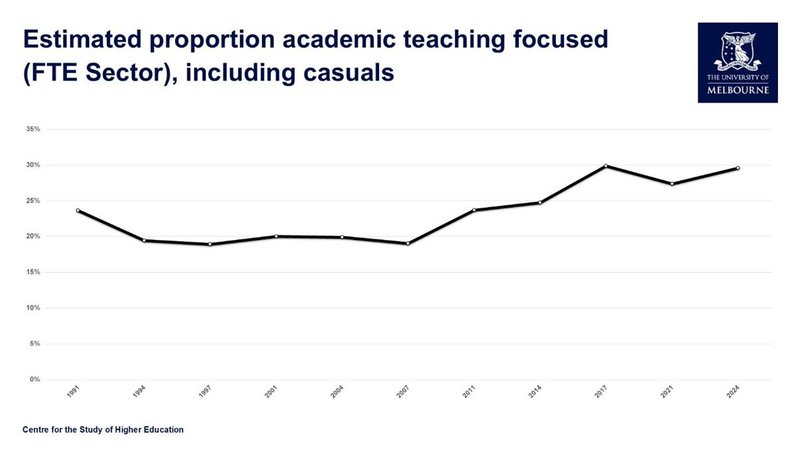
Much of the teaching in Australian universities is now done by more junior academics – many of whom continue to be on casual contracts (approx. 20% of the full-time equivalent academic workforce in 2025).
It is estimated that half or more of Level A academics are teaching-focused casuals. The seniority of teaching-focused academics is shown below.
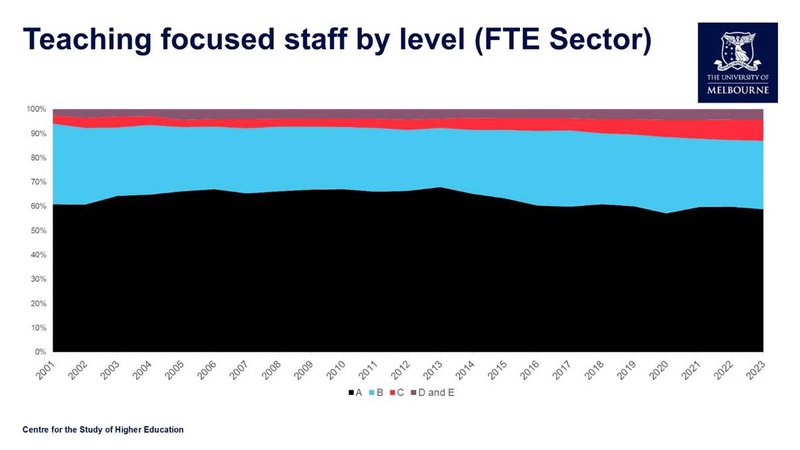
Croucher pointed out that one of the challenges with mandating teaching qualifications is that staff doing the teaching often only stay in their role for a short time – increasing the resource intensity of having to train new staff.
Just over 29% of Level A staff leave each year, compared with 10% of Level E.
Incentivising and rewarding good teaching is, “clearly part of the answer,” Croucher said, with “mandating qualifications alone a potentially costly approach that won’t make the kind of difference for students many people hope. The challenge here is around supporting consistently better quality education, not the lack of a licensing regime.”
There are a range of opportunities to improve teaching capabilities, Croucher said, incorporating teaching qualifications into PhD programs and building teaching competency through bespoke internal professional learning programs that supported early career teachers as they develop over time and time on more senior education responsibilities such as program coordination. There are now a whole spectrum of staff now contributing to education beyond those people often consider traditional academic roles, such learning designers; a more comprehensive institution-wide solution was required to achieve significant outcomes.
“Part of the responsibility for this is back on us,” Professor Croucher said.
“It is reasonable for communities and regulators to want assurance that academics are adequately trained for the roles they perform, but there needs to be flexibility in how they are trained and their competence assessed.”
“Rather than carrying too much anxiety about whether something is going to be mandated, we have the opportunity to tell a story about how the quality of teaching has improved over the past couple of decades, but also to be honest enough to recognise there is a way to go.”
“We need to ensure we are proactive as a sector in addressing concerns, however legitimate or not, before a solution is forced upon us.”